Featured

Are You Strong Enough?

Are you strong enough to bind the chains of Pleiades? Or the Belt of Orion to loosen? Job 38.31

1248211887
Featured

The Veil

The Story is in the Stars

In the constellation Cygnus (Latin for Swan) lies the Cygnus Loop, or the Veil Nebula complex. I say  complex as it is made up of several parts, each of which is a remnant of a supernova between 10,000 and 20,000 years ago. It lies, according to the latest studies, about 2,400 light years distance and it is approximately 120 light years across.[1]

The whole structure is a beautiful nebula to photograph, revealing itself in bright hues of red and blue, which give it a purplish glow through my telescopes.[2] When view and photographing the complex the various parts are easy to distinguish and are large enough and prominent enough that they have their own astronomical designations – The Western Veil, or Witch’s Broom Nebula, The Eastern Veil or Network Nebula, and Pickering’s Triangle. And each of these larger structures contain smaller structures that have been photographed separately.

By definition, a nebula is a structure or cloud of dust formed by the explosion of a star. Scientists posit that the star responsible for the Veil Complex was a star 20 times more massive than the sun.

Here is my observation of the whole Complex using my smaller telescope (Williams Optics RedCat 51) and a one shot color camera (ZWO 2600MC). The smaller scope has a wider field of view and was perfect for capturing the whole structure.

With my larger scope (Explore Scientific 127mm) and a monochrome camera (ZWO 2600MM) using Hydrogen and Oxygen filters I captured the Eastern and Western Veil Nebulae which reside on the outer edges of the larger structure. The massive amount of energy needed to create that structure is far beyond my math! But, that explosion created a really beautiful structure. 


In the TaNaK (Old Testament) we read about how the LORD had the children of Israel construct The Ark and to build a structure in which to house it, the Tabernacle. Part of the structure of the Tabernacle was the Holy of Holies, a part of the Tabernacle in which The Ark was placed and which was completely off limits for everyone save the High Priest, and he would enter only one day out of the year, on Yom Kippur, the Day of Atonement (Lev. 16.30). It was a day in which the “atonement was to be made” to cleanse them from all sin. The Holy of Holies had a veil in front of it that separated the people from The Ark where the LORD resided. This was true of the Tabernacle and later of the Temples (Solomons, Zerubbabel’s, Herod’s).[3] This how Josephus described Herod’s Temple veil

But then this house, as it was divided into two parts, the inner part was lower than the appearance of the outer, and had golden doors of fifty-five cubits altitude, and sixteen in breadth; but before these doors there was a veil of equal largeness with the doors. It was a Babylonian curtain, embroidered with blue, and fine linen, and scarlet, and purple, and of a contexture that was truly wonderful. Nor was this mixture of colors without its mystical interpretation, but was a kind of image of the universe (ὅλων)[4]; for by the scarlet there seemed to be enigmatically signified fire, by the fine flax the earth, by the blue the air, and by the purple the sea; two of them having their colors the foundation of this resemblance; but the fine flax and the purple have their own origin for that foundation, the earth producing the one, and the sea the other. This curtain had also embroidered upon it all that was mystical in the heavens (οὐράνιον), excepting that of the [twelve] signs (ζῳδιακον), representing living creatures.

When I started viewing and photographing the veil nebulae I was reminded of the description of the colors of the Tabernacle and Temple veils in Scripture and in Josephus. It is interesting how Josephus points to the colors as being reflective of the universe and the heavens!

And, as I looked at my photos of the Veil Complex, an astronomical structure that was created with the explosion of a massive star, I was reminded again of the Veil in the Temple and how it was rent much like the nebula. In the Gospels of Matthew and Mark we read

But Jesus cried out again with a loud voice and gave up his spirit.

Suddenly, the curtain of the sanctuary was torn in two from top to bottom, the earth quaked, and the rocks were split. (Matt. 27:50-51 CSB17)

When the centurion, who was standing opposite him, saw the way he breathed his last, he said, “Truly this man was the Son of God!” (Mk. 15:39 CSB17)

There was unimaginable power in the explosion of that star that left the veil nebula as a remnant but truly, there was infinitely more power in the rending of the Veil in the Temple. In the rending of the star that left the nebula, dust and gases were separated and flung light years apart. But, in the rending of the Temple Veil, the separation between the LORD God and Man was removed even further than the diameter of any nebula or galaxy. God had created man “in his image” and he did so that a creature may have perfect fellowship with him. And yet man sinned and separated himself from the God who created him. And without action on God’s  part that separation would be eternal and irreconcilable and no amount of energy created by any action or effort of man or any astronomical object could restore that fellowship. The only one who could was God. But, his nature is Righteousness and Justice. Sin causes that eternal separation and cannot by God be just dismissed like nothing had happened. But, God’s nature includes Mercy and Love. In John’s Gospel we read, “for God so loved the world (κόσμον)[5] that he gave his onlybegotten Son so that all those who believe in him will not perish but have eternal life.”

The giving of his Son was the greatest and most powerful Merciful act of Love that also and necessarily satisfied entirely his Righteousness and Justice.


[1] I am using the web, and in particular Wikipedia for much of the information on the nebula as the articles are extensively documented.

[2] One shot color camera, ZWO2600MC.

[3] Zerubbabel’s and Herod’s Temples are commonly conflated and known as the Second Temple. However, the first century Jewish historian, Josephus, reported that Herod completely razed Zerubbabel’s Second Temple and built a completely new Third Temple (Josephus, Antiquities 15.390).

[4] In this context Josephus is using the word to define everything, the whole universe, hence the translation.

[5] In this instance, as in Romans 5.12 κόσμον refers to the “world of men”.

Featured

Building A Todmorden Pier

So ya wanna build a pier; Wonderful idea, brilliant idea, I had the same idea meownself.

Some of you may not wanna tell your semi-old back what you are about to do!

I wanted a pier as I have come to understand that it saves setup time and makes for better accuracy.

But, we may move out east sometime in not too distant future and so I wanted to lessen the permanent pier factor, consequently I did not want to have to go to concrete pier as its permanency factor was high.

Also, semi-old, semi-retired, semi-stingy so was looking for something cheaper than what most astro companies are selling by way of steel piers.

So, while perusing the broadway of idea sharing on the web I bumped into a little thing called a Todmorden Pier. And then I found this siteA Pier in Our Backyard

http://popupbackpacker.com/a-pier-in-our-backyard/ 

Great site, great narrative of building a pier. So, using it as a guide I began.

The first step in my endeavor to image the sky better and more accurately was to remove two large pecan trees that were right in M31’s path. Squirrels still not happy but I promised to share photos with them.

I then waited ‘til evening and found the best spot to place the pier in my Bortle 8 backyard.

Next, dug the hole, about 18x18x18 inches. Took 4 50 lb bags of concrete to fill. Note the above comment about semi-old backs.

Following his suggestion, I put 4 anchor bolts in a 18×18 slab as the base to set atop the concrete. I made an effort to have the slab level and pretty well pointed to True North (3͗° 15” from magnetic North in my local).

24 hours to set.

I set three 8x8x16 concrete blocks upon which the mount would sit and glued and bolted them together. In hind site, and after setting the mount and telescope, I would have made one of them an 8x8x8 as the telescope tops out at over 8 feet now! I can work around it but if I do a second one (already have the materials) it will be 8 inches shorter. I would also suggest trying to do a pilot hole prior to drilling in the blocks as they ain’t the smoothest things to try to get an accurate hole drilled. And perhaps use a drill bit just a bit larger than the bolts for wiggle room.

Besides the metal pier most folks use, the adapter for the mount that sits atop the pier can be very expensive. As Nick mentions in his site, there is a cheaper and just as effective substitute – a car brake rotor; in the case of the Celestron CGX, a 2010 Malibu LS’s rear rotor. I bought one off of Amazon (ACDelco Silver 18A1675A Rear Disc Brake Rotor) for  $33 and one from AutoZone

(Duralast Brake Rotor 5491) for $59. The Autozone fit just that much better. If I were more patient I would have gone to junk yards for cheaper still but, . . . this ain’t a cheap hobby any way you look at it and despite the lies you tell your spouse!

My brother had a drill press and so I headed his way and he and his son helped me drill the holes that joined the two rotors and the holes that joined the mount to the rotors. My brother had only SAE tap and dies and so we used that to drill and tap the holes to the rotor (a new skill I have picked up!). In hind site I should have sprung the extra bucks for a metric set and then been able to use the one set of screws. It works out because the holes in the mount are about the same size.

Nick suggests that if properly laid, the concrete, slab, and blocks should be level so no need for the elaborate “spider” system some folks have  used to get the two rotors to level the mount. Mine was pretty level but not quite what I wanted to so I used pennies to achieve that last bit of leveling. I may try screws for just that bit more accuracy.

Put on the mount and then the scope. It is tall but solid. I have a border collie who wants to do astrophotography but she always tries to get me to image Sirius (for some reason) and if I don’t she barks and jumps up at the scope so I have installed a Canine Impediment Screen to keep me on the target I want and to keep her from imaging Sirius.

My hope and plan is to build a shed around it, possibly large enough for two piers. LORD willing.

I have so far shot M27 – the Dumbbell Nebula. The pier made the massive difference in set up time and tracking that I was hoping for!

I highly recommend this for you who are considering a pier.

Featured

Eine Kleine Gedankenexperiment

A Little Thought Experiment

This little (kleine) German phrase describes a thought experiment.

Wiki notes,

“The common goal of a thought experiment is to explore the potential consequences of the principle in question:

“A thought experiment is a device with which one performs an intentional, structured process of intellectual deliberation in order to speculate, within a specifiable problem domain, about potential consequents (or antecedents) for a designated antecedent (or consequent)” (Yeates, 2004, p. 150).

Given the structure of the experiment, it may not be possible to perform it, and even if it could be performed, there need not be an intention to perform it.

Examples of thought experiments include Schrödinger’s cat, illustrating quantum indeterminacy through the manipulation of a perfectly sealed environment and a tiny bit of radioactive substance, and Maxwell’s demon, which attempts to demonstrate the ability of a hypothetical finite being to violate the 2nd law of thermodynamics.”

Meown GE involved a pencil and ponderings of the things of the universe.

Back in the halcyon days when I taught Hebrew, I had abhorred the exercises found in the standard textbooks and instead put my students to the task of translating Genesis 1 and 2 as they are to be found in the TaNaK or Old Testament (I prefer TaNaK or TNK and will use that). For those familiar, those two chapters describe how “In the beginning God created.” Those two chapters describe, rather succinctly, the beginnings of everything from the Word of God.

So, as I pondered the no. 2 on my desk I asked myself, “how did it get there?” The question was more ontological than geographic. I thought about what it took to put the graphite (or whatever that is) in the wood, surrouned with the yellow paint with an eraser attached with a metal band. After the initial “what did it take to make the pencil” I wondered, “what did it take to make each part of the pencil; what did it take to make the wood, the graphite (go with me on that), the eraser, the metal?” That led to questions of rock formations, and trees, and all of the things that it took to make them. Which led to the Earth that we live on. And that led to, “how did the earth come to be?” Which led to the Solar System and “how did it come to be?” Which led to the Milky Way . . . well, you see where I am going with this. Very rapidly I came to realize that each smaller item relied on its formation by the next higher item and very soon I am at the level of the Universe as being Necessary for the fact that I had a pencil sitting on my desk.

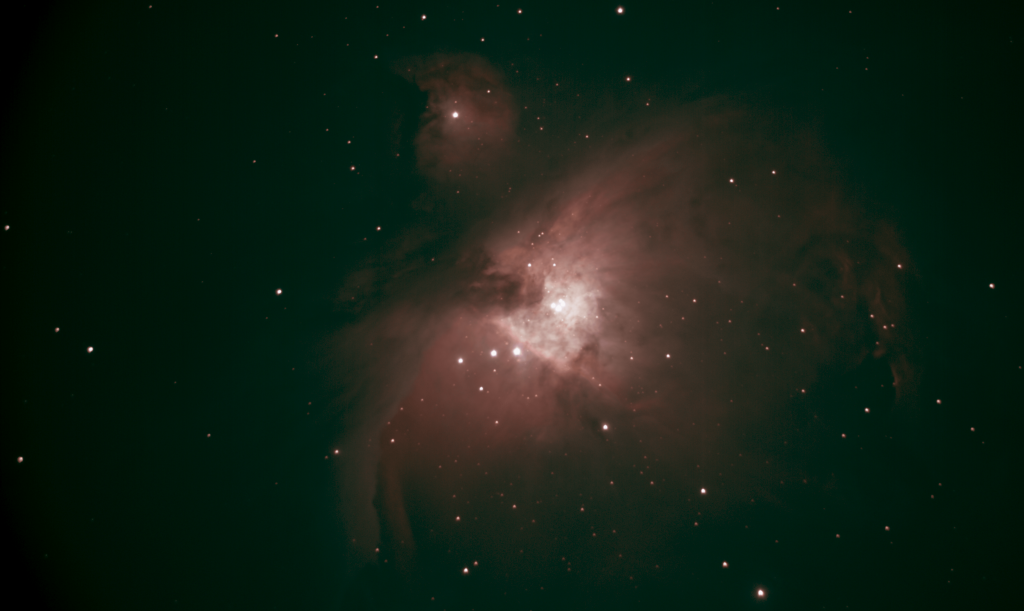
Orion Nebula photographed by Shawn Madden with Celestron 8SE and ASI294c

So, back to that pencil on my desk and my Hebrew classes. What we see in “the Heavens” in such structures as the Orion Nebula are the building blocks and materials that God used as he made all around us and above us and beyond us so that we would have a place to Live and come to Know Him as Roman’s 1.19-20 says, “because what is known of God is clearly seen in them [people]; for God made it visible to them. For the unseen things of him, from the creation of the world the things he made are clearly seen; the everlasting power and divine nature of him . . .” (MOT)

I look up into the heavens and I see His works. His power. His majesty. Yes, even in the dust of the Orion Nebula, which hints at how that pencil came to be found on my desk. And in all of that I remember that He Knows My Name!

What do you think?

The Hubble Palette and Biblical Commentators

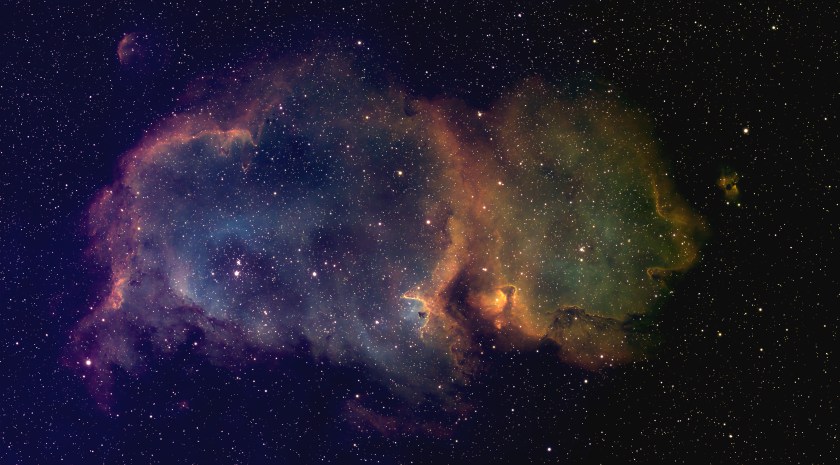
IC 1848, the Soul Nebula (nebula – Latin for cloud or fog), is an emission nebula in the constellation Cassiopeia at about 6,500 light  years from us. According to wiki, “An emission nebula is a nebula formed of ionized gases that emit light of various wavelengths. The most common source of ionization is high-energy ultraviolet photons emitted from a nearby hot star.” The other type of nebula is a planetary nebula which “consist[s] of an expanding, glowing shell of ionized gas ejected from red giant stars late in their lives.” Planetary nebula are so named because their round shaped reminded early astronomers of planets.

I made this photo from over 200 photos taken with my astronomy equipment in my back yard in Dallas, TX. The photos were done with filters in front of the camera that captured the photos from the Sulphur, Oxygen, and Hydrogen wavelengths. I could have taken regular Red, Green, and Blue photos to produce a more natural appearance, which shows up using full color cameras as almost entirely red.

I used the camera and filters that I did because at the time there was a full moon in the sky close enough to the nebula that it would have washed out any effort from using a full spectrum camera. Fortunately the filters that I used are unaffected by the moonlight (and city light for that matter) and so I could still produce a picture albeit in the false colors that you see.

The colors you do see are in what is known as the Hubble Pallet where the Sulphur takes the Red place, Hydrogen the Blue, and Oxygen the Green. Though the colors are false, they do make for stunning images! And, most importantly, they make images available when routine and regular techniques will not work for one reason or another.

As I have noted before, the LORD’s two great works for humanity to observe and “read” are his Word and his Universe.

Both have to be read. And there of various ways of reading and interpreting his books. To read the universe the ideal is to find yourself in a very dark area of the planet and see what rotates about you and above you. What you see is screaming “the LORD! The LORD!!” “For since the creation of the world His invisible attributes, His eternal power and divine nature, have been clearly seen, being understood through what has been made, . . .” (Ex 34.6, Romans 1.20). We can peer even closer to that great witness through our telescopes and by using cameras to make the faint images more visible. Direct observation is best, full color spectrum is better, Hubble Palate will suffice to make specifics clearer.

So too with his Word. The best is a direct communication with the LORD himself but that is few and not very likely for us. But, he did give us the Bible, which we can read ourselves. Ideally, if you have been graced with the opportunity, reading his Word in the orginal languages, Hebrew, Aramaic, and Greeks is the best. For most folks, a translation in our native language is the closest we can get, and that is better.

The next level involves us reading what others have written about what they see God’s Word means. This is at the Hubble palette level – it will suffice but is not the ideal, which is actually reading the text for ourselves.

The truth of the matter is that those church writers and commentators present various degrees of false color, some closer than others. On this subject, some have argued that the closer a writer or commentator gets to proximity with the apostles the more their comments are to be accepted and taken as closer than other writers. But, this is a false dichotomy; the argument that proximity necessarily conveys authority. This is easily shown by the fact that each of the letters of the NT are written to communities founded and known directly by the apostles, including Paul. And the letters written are for the most part written as a correction to something someone who knew the apostles got wrong. If they can err, so can anyone who writes anywhere in church history afterwards, even those who many claim are direct students of the apostles.

The truth of the matter is that any writer, even the apostolic writers, are just commentators, no more inspired or insightful than commentators today. They have their strengths and their weaknesses. Modern commentators have the advantage of having all previous writers at their disposal. And, this is very often forgotten, they didn’t all address every subject and they did not all agree. Scripture is the only body of writings that are inspired. None of the church writers are. They may have good (and erroneous) things to say but they all have to be evaluated for veracity or error.

To make the astrophotography connection, the earliest observations made with the telescope did not have a camera to record what was seen. The observers made drawings of what they saw. Galileo’s drawings of Jupiter and its moons, and the mountains of the moon and spots on the sun are some of the earliest and best known. But they are beginning steps to greater understanding. After the telescope the camera became the greatest aid to gaining greater insight into God’s great and vast creation. It was only in the 1930s with the aid of cameras on telescopes was Edwin Hubble (very much aided by Henrietta Leavitt’s work on the Cepheid variable stars) able to determine and make known that our universe extended far past our own Milky Way Galaxy.

All of this to say, what we observe in his books is aided by, not only the earliest observers and commentators but also, and just as importantly, by those whose observations are more recent and who have read what others have written before them.

It is staggering to me all that the LORD has presented to you and I concerning himself, in his word written in the heavens and in his word written that I hold in my hand!
And, both are written to all of humanity . . .

And to me! The God of the Universe knows my name!

THE GUIDE SCOPE

When doing Astrophotography of Deep Space Objects (DSO) most folks recommend that you get and use a Guide Scope.

To get good, clear photos of DSOs (galaxies, nebulae, star clusters) you need to keep your camera pointed to the object for hours at a time because you will be taking very many photos of that object (hundreds to thousands of photos because of how dim the object are).

For the most part modern mounts (what the telescope sits on) do a fair job of finding and tracking those objects and keeping them generally align and centered in the camera’s field of view. But, not enough to get accurate, detailed pictures of the object, especially when you are taking so many.

To get the photos right and clear you need a Guide Scope (GS). In the photo you can see the guide scope sitting atop the Imaging Scope (IS). The two scopes need to be aligned and bore sighted to ensure that they will be pointing to the same area of space that your object is in. What you do is to point the GS at a star that is in the field of view as  your object and use a program such as PHD (Push Here Dummy according to some sources) to keep the GS locked onto the star and tie the GS camera to the mount (notice the two wires coming off of the GS camera) so that it can send signals to the mount to have it move to keep the guide star centered in the GS camera and thereby keeping the DSO centered in the main imaging camera for the duration of the shoot.

Some folks do astrophotography for the art and beauty of the pictures. Some do it to study the universe in which we reside in an effort to understand more about our place in the grand scheme of things while also appreciating the beauty of the quest as seen in the photos of the stars and planets and galaxies and nebulae and other objects beyond the bounds of our neighborhood.

I like to think that I fall in the latter category. I love the photos I have produced, despite their obvious amateurishness (I hope to get better) and at the same time for me seeing them is a gateway to the understanding and appreciation of the One who set them out there for me to see and wonder over and about.

I have studied this enough to come to the very strong conclusion that what is out there is not a result of unconscious accident. The complexity and beauty of what I see (so too what those who observe the micro biological and physical realms) has got to be from the mind and hands of an Engineer far beyond the capabilities of the greatest minds in the history of the earth. So too, the idea that it all is a matter of sudden appearance from nothing with no cause flies in the face of logic. Dean Overman in his A Case Against Accident and Self-Organization dealt with this nicely. There is someone behind all of this.

Just like the pencil I talked about sitting on my desk, I knew that someone had designed that pencil – it just didn’t pop into existence on its own. It had to have been designed by someone. So too the materials of which it is composed – they just did not pop into existence, and, someone had to design those materials. And this applies to everything in that string of things that I observed were responsible for the fact that I had a pencil on my desk or that Carl Sagan concluded allowed him to enjoy an apple pie.

My study has also led me to the conclusion that that Person is the the God of Abraham and Jesus; YHWH, the God of Israel who gave us the Bible with which to know Him and understand Him and to understand what He would have of us in our relationship with him.

As such, just like if I want to learn and understand what I see through my telescope I need something to guide me. For that I have the Bible as my Guide Scope as it keeps me locked onto the Guide Star who is responsible for both the pencil and me who noticed it! In this I recognize the fact that the One who Designed the Universe is the One who Wrote The Bible. They both have the same Author. Now, before anyone says it, yes, the Bible does  not give detailed information concerning the intricacies and the details of sub-quantum things and their design but it does speak enough of who that Engineer is who designs at the sub-quantum/plank level for me to begin to come to a greater understanding of how we fit into this unbelievably vast cosmos.

And, He knows my name and he knows your name!

Light and Inflation

Genesis 1.3, Light, and Inflation

While reading Genesis 1 have you noticed that light does not show up until verse 3? Depending on how you read it, there is quite a bit of creation and matter long before light shows up.

I have inserted tabs at the beginning of clauses. What the tabs show is varying degrees of primacy in the text – i.e., mainline clause and supporting clauses. The clauses without tabs are the mainline clauses as shown by the specific Hebrew verb form. Clausal forms and elements are the grammatical clues to the hierarchy of the clauses in their relationship to each other and to the overall text. In this text we have a mainline narrative text and a mainline hortatory (imperatival) clause (3a, 3c); a background action clause (1), a background activities clause (2c) and three setting clauses (2a, 2b, 3c).

In evaluating a text, I normally remove the verse markers to get rid of any influence of the versifier and evaluate the text as a literary block. When done this way it can be seen how the text was meant to be read.

The grammatical markers (clausal structure mainly) are the indicators that the author used to show how he wanted the text to flow and what the main point was and what was backgrounding and support structures. I find it useful to think of a stage or a movie scene. You have the background or setting of the stage or scene. Then you have the background activities-things movie around giving more contextual information. Then you have background action – things happening closer to the front of the stage but not quite the main action. Then, closest to the audience and in focus you have the main action. The author of a text sets the stage and demonstrates the action by his clausal elements and structures.

The creation at the beginning (1) sets up what is to follow but did it in such a way as to provide background action to the main action – the creation of light. 2a-c gives the state of the creation prior to the creation of light; it provides the setting and background activity to the stage structure before the main action.

The main action is God speaking light into existence. It is very distinct in the Hebrew text by virtue of the verb form and the fact that that form is always found at the front of the clause.

1-2 is all background and setting. Structured the way it is it can take up any amount of time – microseconds to billions of years. The grammar of the text allows that. Day 1 does not begin until 3a. If you look at the rest of Gen 1 each day begins the same – and God said . . . ; and ends the same – there was evening, there was morning, day umptifratz.

So, in the text we have the Initial Creation with a description of the state of the universe (heavens and earth) prior to the creation of light. Notice that it is a distinct event separated from the initial creation. When I started paying attention to what I was seeing I thought it odd; I have a background in explosives and usually associate Bangs with Light!

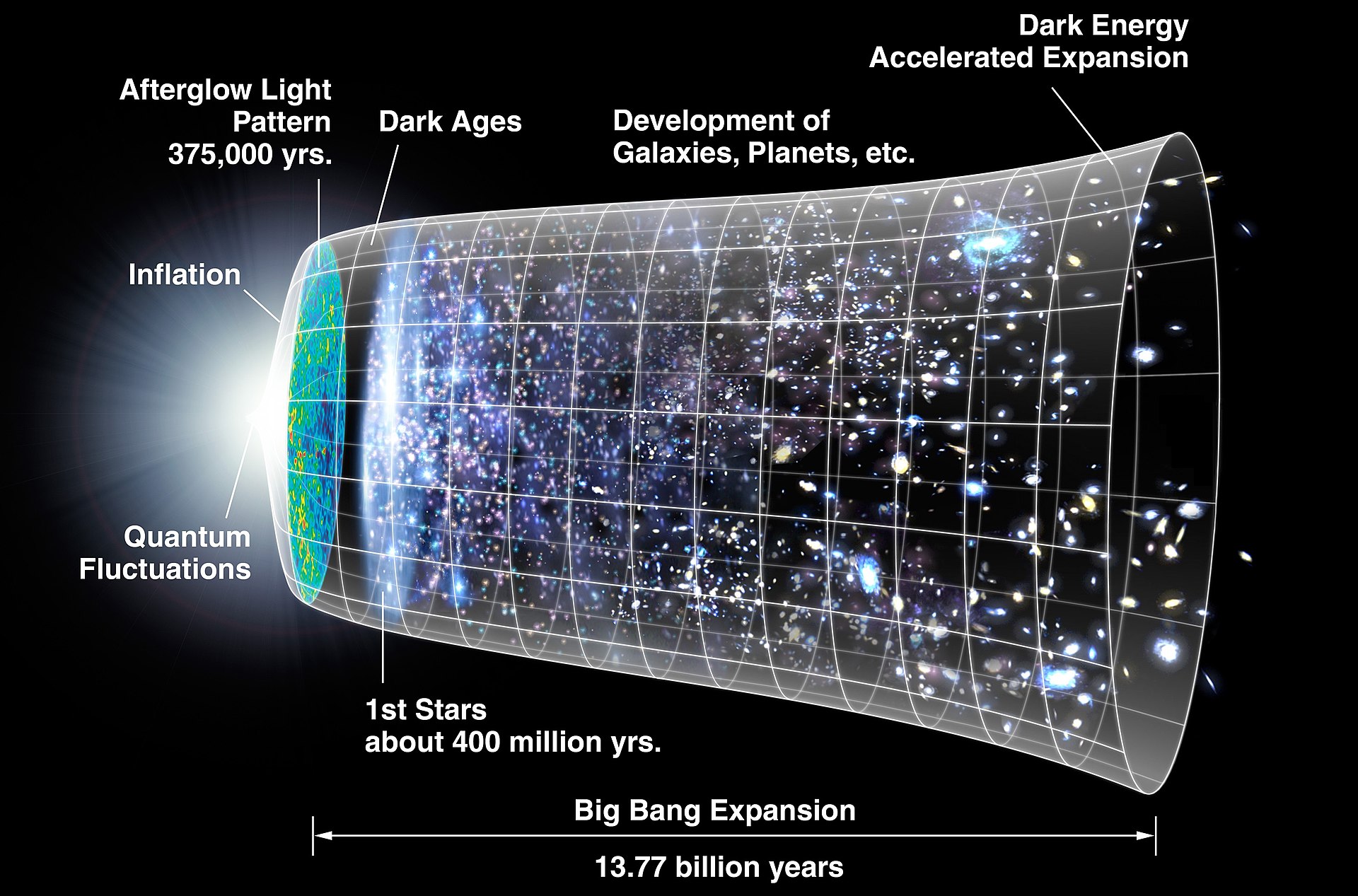
When you look at the theory of the Big Bang and the illustrations of it you find that there is an initial period when the initial universe was too hot for the existence or travel of photons. It is call by some theorists the Cosmic Dark Ages and how long it lasted varies depending on the theorist.  Wikipedia’s article on “The Chronology  of the Universe” notes, “The Dark Ages and large-scale structure emergence – From 370,000 years until about 1 billion years. After recombination and decoupling, the universe was transparent but the clouds of hydrogen only collapsed very slowly to form stars and galaxies, so there were no new sources of light. The only photons (electromagnetic radiation, or “light”) in the universe were those released during decoupling (visible today as the cosmic microwave background) and 21 cm radio emissions occasionally emitted by hydrogen atoms. The decoupled photons would have filled the universe with a brilliant pale orange glow at first, gradually redshifting to non-visible wavelengths after about 3 million years, leaving it without visible light. This period is known as the cosmic Dark Ages. (https://en.wikipedia.org/wiki/Chronology_of_the_universe)

So here we have an observation from the Text and an observation from Telescopes pointed to the furthest reaches of the observable Creation that show a pause of some value between the initial creation and the creation and emergeance of light. It seems that grammar and science agree.

Not unexpected when we remember that both have the same Author. Who is also an Engineer who designs on the Sub-Atomic (sub-Plank?!) level. And, Who knows Your Name.

Language, Symbols, and the 2000 year old comma

To communicate anything there has to be a recognizable set of symbols which both parties are familiar and conversant.

In human language we talk about symbols cultures have created and utilized to convey meaning. Some written languages have symbols that represent the sounds of spoken language. Some symbols represent discrete sounds (alphabets) and some represent syllables (syllabary). Some written languages use the symbols to convey meaning that may not be directly related to sounds or may allow different spoken sounds for the same symbol (pictographic).

For the purposes of this paper I will stick to alphabet languages and use them to relate to other fields and concepts.

In alphabet languages each letter normally represents a particular sound and combinations of letters make more complete sounds like syllables and words. Letters may be combined in a myriad of ways to depict vast numbers of words and meanings.

So too, syllables may be combined in a variety of ways to depict words.

And then words combine to make phrases, clauses, and sentences.

And sentences combine to make paragraphs. And from there we are off to a wide variety of discourse types each laid out to present particular bits of information.

So too with numbers and the language of math and of programming.

Numbers stand alone and relate to other numbers and combine to form specific functions and can be modified by their relationship to decimal points and whether they are on the line, raised above it or lowered below it. Usually, discussions refer to combinations, whether letters or numbers, the value of those in relation to other letters of numbers, and the relationship of those structures to other combinations and groups of combinations.

So, generally, for math discussions not often do folks talk about a single number without mentioning in what context that number or number phrase is found.

So too with letters and words. What those mean is best understood in the context of their presentation. As such, it is more useful to talk not so much about the word as the use of the word in the context of the phrase, clause, paragraph or larger grammatical structure.

So too with punctuation and its relation to the surrounding grammar and the context it is found in.

For instance, in Luke 4 we have a comma whose value so far is 2,000 years.

There we find recorded that Jesus went to his hometown synagogue in Nazareth (small village) and he stood up to read from the book of Isaiah. (Side note – small village synagogue has a copy of Isaiah. More than good chance that small synagogue has then entire TaNaK/OT). The passage is from Isaiah 61.1-2a. The literary extent of the passage extends to verse 11.

In the New American Standard I am looking at, in the Isaiah passage there is a comma at 2a separating it from 2b. The Massoretic notation in the Hebrew text has a zaqeph qaton which is somewhat analogous to a comma.

So why did Jesus stop at 2a?

Contrary to what the Pharisees et al expected, Jesus made the point that the Messiah would First come to Serve and then he would come to Rule. The pause in the passage is the pause between the First Coming Serving Messiah and the Second Coming Ruling Messiah.

As it is, that Comma represents right around 2,000 years!

This is a hint that in other passages there may be found chronological pauses or gaps if we pay attention to the whole of Scripture and pay close attention to the grammatical structure each biblical author was moved to use when the Holy Spirit used them to write God’s Word.

The Glory of God and the Glory of Kings

My son in law’s favorite verse is Proverbs 25.2 which says, “[it is the] glory of God to cause the hiding of a thing; and [the] glory of kings to search [for the] thing.”

God created a vast universe, and I argue, he designed, engineered, and created from, at the very least, the sub-quantum level. If we admit to the kind of person that is capable of such and recognize how that is near infinitely beyond both our imaginings and abilities then you recognize what Solomon is saying. It seems that Solomon recognized the greatness of God and also that God made man to want to investigate and search for his ways. Notice that the verse did not say “find or discover”! As many have noted in the things of man, many times it is the quest and journey that is more than the arriving and finding. Some things we have discovered but I think that most will admit we are nibbling at the edges! But what nibblings!

This blog is dedicated to such a quest and discussion. There are varying degrees of a person’s pursuing such a quest, such treasures of “how he did it” that involve looking at both the evidence he lays out before all men in the world around us and the universe above us and also in the text of the Word he gave us as direct communication and revelation.

When doing either you can rely on the work of others that lays out their discoveries. For the text this involves reading translations of the Bible; for the world and universe this involves accessing someone else’s work in the multiplicity of the sciences. Happy is the one who can do some of the investigations on their own either by making their own translations and discoveries in one or all three of the biblical languages (Hebrew, Aramaic, Greek) and/or making their own scientific investigations and discoveries in one or many fields (astronomy, biology, etc.).

As much as possible (but not always) I will be making my own translations (as above with Pr. 25.2) and providing my own photographs to make the point or observation that I will be writing about. To that end I have provided my own translation and here are my earliest photographs of a few of our solar system neighbors.

Genesis 1.1-3 – Time, Space, and Discourse Grammar

One of my primary teachings to my Hebrew students was, “Let the grammar determine your theology.”

The more I delved into the text of Scripture the more I was amazed at the precision of the grammar. This led me to study Discourse Grammar as taught by Robert Longacre (quick overview here). What follows is a very brief introduction to the concept using the first verses of Genesis and what may be gleaned by an understanding of what the Author had his amanuensis do with rather precise grammar.

Quick side lesson here on an author and his grammar – if he could have written it a different way then we need to look closely into why he wrote it in the way that he did.

Gen. 1.1-3

1 בראשׁית ברא אלהים את השׁמים ואת הארץ⇐

2a והארץ היתה תהו ובהו⇐⇐⇐

2b וחשׁך על פני תהום⇐⇐⇐

2c ורוח אלהים מרחפת על פני האמים⇐⇐

 3a ויאמר אלהים

 3b יהי אור

3c ויהי אור⇐⇐⇐⇐

1 ⇒In the beginning God created the heavens and the earth

2a ⇒⇒⇒And the earth was formless and void

2b ⇒⇒⇒And darkness was upon the face of the deep

2c ⇒⇒And the spirit of God was hovering upon the face of the waters

3a And God said

3b Let there be light

3c ⇒⇒⇒And there was light

I have inserted arrows at the beginning of clauses to demonstrate tabs which I am not sure how to do on the web without dropping in a pdf file (if you know how shoot me an e-mail!).

What the tabs show are varying degrees of primacy in the text – i.e., mainline clause and supporting clauses. The clauses without tabs are the mainline clauses as shown by the specific Hebrew verb form. Clausal forms and elements are the grammatical clues to the hierarchy of the clauses in their relationship to each other and to the overall text. In this text we have a mainline narrative text and a mainline hortatory (imperatival) clause (3a, 3c); a background action clause (1), a back ground activities clause (2c) and three setting clauses (2a, 2b, 3c).

In evaluating a text I normally remove the verse markers to get rid of any influence of the versifier and evaluate the text as a literary block. When done this way it can be seen how the text was meant to be read.

The grammatical markers (clausal structure mainly) are the indicators that the author used to show how he wanted the text to flow and what the main point was and what was backgrounding and support structures. I find it useful to think of a stage or a movie scene. You have the background or setting of the stage or scene. Then you have the background activities-things movie around giving more contextual information. Then you have back ground action – things happening closer to the front of the stage but not quite the main action. Then, closest to the audience and in focus you have the main action. The author of a text sets the stage and demonstrates the action by his clausal elements and structures.

The creation at the beginning (1) sets up what is to follow but did it in such a way as to provide background action to the main action – the creation of light. 2a-c gives the state of the creation prior to the creation of light; it provides the setting and background activity to the stage structure before the main action.

The main action is God speaking light into existence. It is very distinct in the Hebrew text by virtue of the verb form and the fact that that form is always found at the front of the clause.

1-2 is all background and setting. Structured the way it is it can take up any amount of time – microseconds to billions of years. The grammar of the text allows that. Day 1 does not begin until 3a. If you look at the rest of Gen 1 each day begins the same – and God said . . . ; and ends the same – there was evening, there was morning, day Umptifratz (highly theo-scientific technical term derived from a Hebrew root).