Are you strong enough to bind the chains of Pleiades? Or the Belt of Orion to loosen? Job 38.31
Are you strong enough to bind the chains of Pleiades?Or the Belt of Orion to loosen? Job 38.31
As I have gotten into the hobby and art of astrophotography, it was very interesting to me when I recognized that some of the constellations and figures of the night sky are mentioned in Scripture. In our English translations we find mention in the book of Job the Bear, Orion, and Pleiades. So too in the book of Amos. Here are the verses –
Job 9.9 [Job speaking] He who makes the Bear, Orion, and Pleiades and the chambers of the south Job 38.31 [the LORD speaking] Can you bind the chains of Pleiades or loose the cords of Orion?
Amos 5.8 He who makes the Pleiades and Orion, turns the darkness to morning
In Hebrew, the word used to refer to the constellation we know as Pleiades is kiymah (כִימָה) and we get our English word from the Greek word pleiados (Πλειάδος).
The Hebrew the word used to refer to the constellation we know as Orion is kǝsiyl (כְסִיל) and we get our English word from the Greek word ōriōnos (Ὠρίωνος).
A former student of mine asked how Scripture came to name heavenly structures that bear Greek names. My brief research (Wikipedia) indicates that the Scriptural references are among the oldest, if not the oldest, in ancient literature. What is found in the Hebrew writings predates the writings of the Greeks. Knowing this and knowing also, that beginning at about 250 B.C. the Hebrew Scriptures were begun to be translated into Greek to help with the collection of books in the ancient library at Alexandria, it was easy for me to imagine the translation process. When the Jewish elder got to these passages, I imagine that he queried his Greek assistant and, pointing to the night sky asked, “See that group of stars there? What do you call them in Greek?” So, from the Hebrew word to the Greek word and then on to English which has since, the time of the Greeks, retained the Greek names.
1248211887
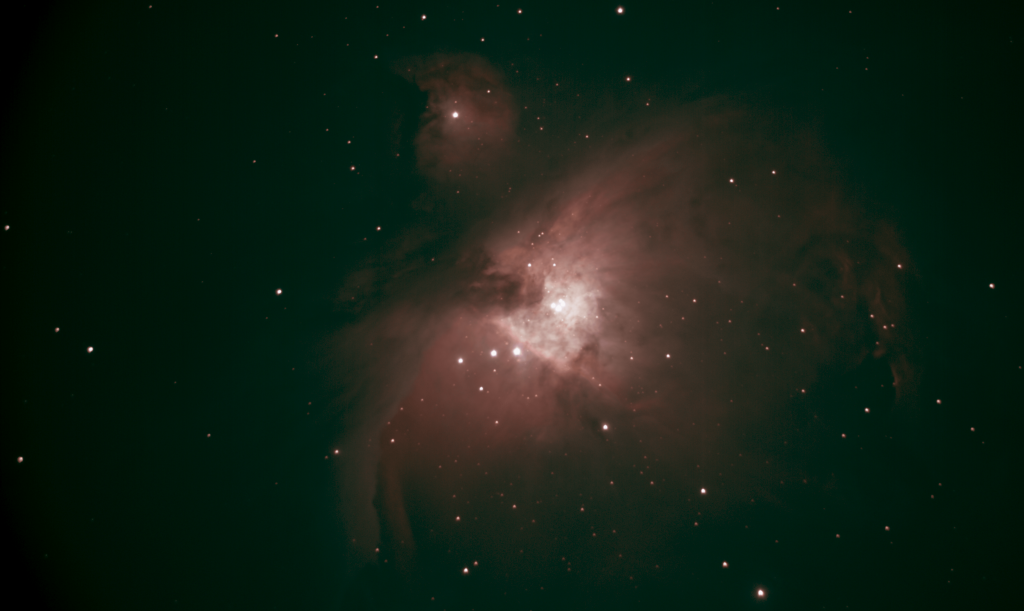
The Orion constellation is visible in the southern sky in the northern hemisphere in the winter months at night. As I write this from Dallas, Texas, in mid March it is moving closer to the sunset earlier and earlier each night so as to disappear from viewing in late April. It will reappear in the eastern night sky at the end of December. It is one of the most easily recognized constellations because the three most prominent stars that make up the belt of Orion – Alnitak (Arabicالنطاق an-niṭāq, the girdle 1,200 light years distance), Alnilam (Arabic النظام al-niẓām the arrangement/string, 2,000 light years distance), and Mintaka (Arabic term for ‘belt’: منطقة manṭaqa – 1200 light years distance). Below the belt or to the right of it, depending on the time of the night, can be found one of the prominent structures, the Orion Nebulas (M-42 in the Messier Catalog). It is perhaps the most popular structure in the night sky to view and to photograph. This post has at its head my most recent photo of it. It is really stunning the first time you see it and photograph it through a telescope.
Pleiades is not so much a constellation as a star cluster. It appears at about the same time as Orion. Wikipedia notes this about the Greek name, “The name of the Pleiades comes from Ancient Greek: Πλειάδες. It probably derives from plein (“to sail”) because of the cluster’s importance in delimiting the sailing season in the Mediterranean Sea: “the season of navigation began with their heliacal rising”. However, in mythology the name was used for the Pleiades, seven divine sisters, the name supposedly deriving from that of their mother Pleione and effectively meaning “daughters of Pleione”. In reality, the name of the star cluster almost certainly came first, and Pleione was invented to explain it.” (https://en.wikipedia.org/wiki/Pleiades). The most prominent stars that make up the cluster are about 350 to 450 light years distance.
As noted in the text, the incomprehensible power and majesty of the LORD God that the writers of Job and Amos recognized was illustrated by their references to the fabulous constellations and star clusters that they mentioned. So does Paul to the Romans in chapter 1 of his letter to the Romans. Their point is a contrast to the absolute feebleness of man and his inability to answer or stand in judgement of the words or actions of the LORD.
Interestingly enough, the narrative in Job concerns this. Unknown to Job or his friends what was happening to Job was beyond their knowledge or understanding. Job’s friends put forth the charge that Job must have done something wrong for such calamities and evils to befall him and each of them in their turn tried to convince him of that. But Job knew that he had done nothing that would be considered a violation of God’s ways or justice. He felt that he was righteous in his living. Indeed, in Ezekiel 14.14 and 14.20, Job is named as one of the three righteous men in the earth, Noah and Daniel, Ezekiel’s contemporary, being the other two.
And, in a way, this addresses the great question of theodicy that has been debated for millennia – how to reconcile a good God with the presence of evil. In the case of Job, the answer is that God permits evil things for his own purposes, reasons of which we have no real idea, and, more importantly, no real right or power to question. Our response should ever be a recognition that we are creatures and not the creator and completely unable to comprehend the ways and purposes of God, but, at the same time, recognize the we are his creation and what happens to us at his hands he is in total control and has our best interest in mind when things happen to us. Will we know that in this lifetime? The answer from Job is “probably not,” but I am convinced that as we cross the river into his presence we will know completely. I am also of the opinion, and some of this from personal hardship, that he will sustain us through what comes our way, and like Job I will say, “though he slay me, I will hope in him” and like the three companions of Daniel, when faced with the fiery furnace and a horrible death, told to Nebuchadnezzar, “even if God does not deliver us from death in your fiery furnace we will still obey and trust him.”
And, in all of this, there is a lesson from Amos when he recognizes the power of the LORD to “turn darkness into morning.” So too we can recognize the LORD can also turn the darknesses that we encounter in our lives into mornings of blessing, joy, and rejoicing! The power to control celestial objects and events also is turned by our loving Lord into healing and joy.
In the constellation Cygnus (Latin for Swan) lies the Cygnus Loop, or the Veil Nebula complex. I say complex as it is made up of several parts, each of which is a remnant of a supernova between 10,000 and 20,000 years ago. It lies, according to the latest studies, about 2,400 light years distance and it is approximately 120 light years across.[1]
The whole structure is a beautiful nebula to photograph, revealing itself in bright hues of red and blue, which give it a purplish glow through my telescopes.[2] When view and photographing the complex the various parts are easy to distinguish and are large enough and prominent enough that they have their own astronomical designations – The Western Veil, or Witch’s Broom Nebula, The Eastern Veil or Network Nebula, and Pickering’s Triangle. And each of these larger structures contain smaller structures that have been photographed separately.
By definition, a nebula is a structure or cloud of dust formed by the explosion of a star. Scientists posit that the star responsible for the Veil Complex was a star 20 times more massive than the sun.
Here is my observation of the whole Complex using my smaller telescope (Williams Optics RedCat 51) and a one shot color camera (ZWO 2600MC). The smaller scope has a wider field of view and was perfect for capturing the whole structure.
With my larger scope (Explore Scientific 127mm) and a monochrome camera (ZWO 2600MM) using Hydrogen and Oxygen filters I captured the Eastern and Western Veil Nebulae which reside on the outer edges of the larger structure. The massive amount of energy needed to create that structure is far beyond my math! But, that explosion created a really beautiful structure.
In the TaNaK (Old Testament) we read about how the LORD had the children of Israel construct The Ark and to build a structure in which to house it, the Tabernacle. Part of the structure of the Tabernacle was the Holy of Holies, a part of the Tabernacle in which The Ark was placed and which was completely off limits for everyone save the High Priest, and he would enter only one day out of the year, on Yom Kippur, the Day of Atonement (Lev. 16.30). It was a day in which the “atonement was to be made” to cleanse them from all sin. The Holy of Holies had a veil in front of it that separated the people from The Ark where the LORD resided. This was true of the Tabernacle and later of the Temples (Solomons, Zerubbabel’s, Herod’s).[3] This how Josephus described Herod’s Temple veil
But then this house, as it was divided into two parts, the inner part was lower than the appearance of the outer, and had golden doors of fifty-five cubits altitude, and sixteen in breadth; but before these doors there was a veil of equal largeness with the doors. It was a Babylonian curtain, embroidered with blue, and fine linen, and scarlet, and purple, and of a contexture that was truly wonderful. Nor was this mixture of colors without its mystical interpretation, but was a kind of image of the universe (ὅλων)[4]; for by the scarlet there seemed to be enigmatically signified fire, by the fine flax the earth, by the blue the air, and by the purple the sea; two of them having their colors the foundation of this resemblance; but the fine flax and the purple have their own origin for that foundation, the earth producing the one, and the sea the other. This curtain had also embroidered upon it all that was mystical in the heavens (οὐράνιον), excepting that of the [twelve] signs (ζῳδιακον), representing living creatures.
When I started viewing and photographing the veil nebulae I was reminded of the description of the colors of the Tabernacle and Temple veils in Scripture and in Josephus. It is interesting how Josephus points to the colors as being reflective of the universe and the heavens!
And, as I looked at my photos of the Veil Complex, an astronomical structure that was created with the explosion of a massive star, I was reminded again of the Veil in the Temple and how it was rent much like the nebula. In the Gospels of Matthew and Mark we read
But Jesus cried out again with a loud voice and gave up his spirit.
Suddenly, the curtain of the sanctuary was torn in two from top to bottom, the earth quaked, and the rocks were split. (Matt. 27:50-51 CSB17)
When the centurion, who was standing opposite him, saw the way he breathed his last, he said, “Truly this man was the Son of God!” (Mk. 15:39 CSB17)
There was unimaginable power in the explosion of that star that left the veil nebula as a remnant but truly, there was infinitely more power in the rending of the Veil in the Temple. In the rending of the star that left the nebula, dust and gases were separated and flung light years apart. But, in the rending of the Temple Veil, the separation between the LORD God and Man was removed even further than the diameter of any nebula or galaxy. God had created man “in his image” and he did so that a creature may have perfect fellowship with him. And yet man sinned and separated himself from the God who created him. And without action on God’s part that separation would be eternal and irreconcilable and no amount of energy created by any action or effort of man or any astronomical object could restore that fellowship. The only one who could was God. But, his nature is Righteousness and Justice. Sin causes that eternal separation and cannot by God be just dismissed like nothing had happened. But, God’s nature includes Mercy and Love. In John’s Gospel we read, “for God so loved the world (κόσμον)[5] that he gave his onlybegotten Son so that all those who believe in him will not perish but have eternal life.”
The giving of his Son was the greatest and most powerful Merciful act of Love that also and necessarily satisfied entirely his Righteousness and Justice.
[1] I am using the web, and in particular Wikipedia for much of the information on the nebula as the articles are extensively documented.
[3] Zerubbabel’s and Herod’s Temples are commonly conflated and known as the Second Temple. However, the first century Jewish historian, Josephus, reported that Herod completely razed Zerubbabel’s Second Temple and built a completely new Third Temple (Josephus, Antiquities 15.390).
[4] In this context Josephus is using the word to define everything, the whole universe, hence the translation.
[5] In this instance, as in Romans 5.12 κόσμον refers to the “world of men”.
So ya wanna build a pier; Wonderful idea, brilliant idea, I had the same idea meownself.
Some of you may not wanna tell your semi-old back what you are about to do!
I wanted a pier as I have come to understand that it saves setup time and makes for better accuracy.
But, we may move out east sometime in not too distant future and so I wanted to lessen the permanent pier factor, consequently I did not want to have to go to concrete pier as its permanency factor was high.
Also, semi-old, semi-retired, semi-stingy so was looking for something cheaper than what most astro companies are selling by way of steel piers.
So, while perusing the broadway of idea sharing on the web I bumped into a little thing called a Todmorden Pier. And then I found this site – A Pier in Our Backyard
Great site, great narrative of building a pier. So, using it as a guide I began.
The first step in my endeavor to image the sky better and more accurately was to remove two large pecan trees that were right in M31’s path. Squirrels still not happy but I promised to share photos with them.
I then waited ‘til evening and found the best spot to place the pier in my Bortle 8 backyard.
Next, dug the hole, about 18x18x18 inches. Took 4 50 lb bags of concrete to fill. Note the above comment about semi-old backs.
Following his suggestion, I put 4 anchor bolts in a 18×18 slab as the base to set atop the concrete. I made an effort to have the slab level and pretty well pointed to True North (3͗° 15” from magnetic North in my local).
24 hours to set.
I set three 8x8x16 concrete blocks upon which the mount would sit and glued and bolted them together. In hind site, and after setting the mount and telescope, I would have made one of them an 8x8x8 as the telescope tops out at over 8 feet now! I can work around it but if I do a second one (already have the materials) it will be 8 inches shorter. I would also suggest trying to do a pilot hole prior to drilling in the blocks as they ain’t the smoothest things to try to get an accurate hole drilled. And perhaps use a drill bit just a bit larger than the bolts for wiggle room.
Besides the metal pier most folks use, the adapter for the mount that sits atop the pier can be very expensive. As Nick mentions in his site, there is a cheaper and just as effective substitute – a car brake rotor; in the case of the Celestron CGX, a 2010 Malibu LS’s rear rotor. I bought one off of Amazon (ACDelco Silver 18A1675A Rear Disc Brake Rotor) for $33 and one from AutoZone
(Duralast Brake Rotor 5491) for $59. The Autozone fit just that much better. If I were more patient I would have gone to junk yards for cheaper still but, . . . this ain’t a cheap hobby any way you look at it and despite the lies you tell your spouse!
My brother had a drill press and so I headed his way and he and his son helped me drill the holes that joined the two rotors and the holes that joined the mount to the rotors. My brother had only SAE tap and dies and so we used that to drill and tap the holes to the rotor (a new skill I have picked up!). In hind site I should have sprung the extra bucks for a metric set and then been able to use the one set of screws. It works out because the holes in the mount are about the same size.
Nick suggests that if properly laid, the concrete, slab, and blocks should be level so no need for the elaborate “spider” system some folks have used to get the two rotors to level the mount. Mine was pretty level but not quite what I wanted to so I used pennies to achieve that last bit of leveling. I may try screws for just that bit more accuracy.
Put on the mount and then the scope. It is tall but solid. I have a border collie who wants to do astrophotography but she always tries to get me to image Sirius (for some reason) and if I don’t she barks and jumps up at the scope so I have installed a Canine Impediment Screen to keep me on the target I want and to keep her from imaging Sirius.
My hope and plan is to build a shed around it, possibly large enough for two piers. LORD willing.
I have so far shot M27 – the Dumbbell Nebula. The pier made the massive difference in set up time and tracking that I was hoping for!
I highly recommend this for you who are considering a pier.
This little (kleine) German phrase describes a thought experiment.
Wiki notes,
“The common goal of a thought experiment is to explore the potential consequences of the principle in question:
“A thought experiment is a device with which one performs an intentional, structured process of intellectual deliberation in order to speculate, within a specifiable problem domain, about potential consequents (or antecedents) for a designated antecedent (or consequent)” (Yeates, 2004, p. 150).
Given the structure of the experiment, it may not be possible to perform it, and even if it could be performed, there need not be an intention to perform it.
Examples of thought experiments include Schrödinger’s cat, illustrating quantum indeterminacy through the manipulation of a perfectly sealed environment and a tiny bit of radioactive substance, and Maxwell’s demon, which attempts to demonstrate the ability of a hypothetical finite being to violate the 2nd law of thermodynamics.”
Meown GE involved a pencil and ponderings of the things of the universe.
Back in the halcyon days when I taught Hebrew, I had abhorred the exercises found in the standard textbooks and instead put my students to the task of translating Genesis 1 and 2 as they are to be found in the TaNaK or Old Testament (I prefer TaNaK or TNK and will use that). For those familiar, those two chapters describe how “In the beginning God created.” Those two chapters describe, rather succinctly, the beginnings of everything from the Word of God.
So, as I pondered the no. 2 on my desk I asked myself, “how did it get there?” The question was more ontological than geographic. I thought about what it took to put the graphite (or whatever that is) in the wood, surrouned with the yellow paint with an eraser attached with a metal band. After the initial “what did it take to make the pencil” I wondered, “what did it take to make each part of the pencil; what did it take to make the wood, the graphite (go with me on that), the eraser, the metal?” That led to questions of rock formations, and trees, and all of the things that it took to make them. Which led to the Earth that we live on. And that led to, “how did the earth come to be?” Which led to the Solar System and “how did it come to be?” Which led to the Milky Way . . . well, you see where I am going with this. Very rapidly I came to realize that each smaller item relied on its formation by the next higher item and very soon I am at the level of the Universe as being Necessary for the fact that I had a pencil sitting on my desk.
So, back to that pencil on my desk and my Hebrew classes. What we see in “the Heavens” in such structures as the Orion Nebula are the building blocks and materials that God used as he made all around us and above us and beyond us so that we would have a place to Live and come to Know Him as Roman’s 1.19-20 says, “because what is known of God is clearly seen in them [people]; for God made it visible to them. For the unseen things of him, from the creation of the world the things he made are clearly seen; the everlasting power and divine nature of him . . .” (MOT)
I look up into the heavens and I see His works. His power. His majesty. Yes, even in the dust of the Orion Nebula, which hints at how that pencil came to be found on my desk. And in all of that I remember that He Knows My Name!
Shawn C. Madden* Abstract: Genesis 1 has been an enigma to exegetes and scientists since man has read the text and read the heavens. Attempts to reconcile or match the two sources of the creative 1activity of God has garnered discussion and debate, often very heated, for millennia. Each time a new way of interpreting the text or peering more closely at the heavens has advanced the discussion and the attempts at finding or recognizing agreements between the two books God has written – Scripture and Nature. While the books have remained unchanged, the hermeneutical tools aimed at evaluating each, linguistics and science, have advanced. This paper is an attempt at providing yet another effort at seeing the agreements in the two books of God. The long history of such endeavors tempers this effort and the author knows that this will not be the end of the discussion and that this paper may achieve no more than to find itself as another item in the catalog of efforts of the creature attempting to understand and proclaim the glory and majesty of the Creator.
Key Words: Genesis 1:1-3, hermeneutics, text linguistics, discourse analysis, creation, Big Bang, science, physics, Hebrew grammar, day, cosmology, universe, earth.
The Bible shows the way to go to heaven, not the way the heavens go. Galileo Galilei (1564- 1642) in his open letter to the Dowager Grand Duchess.[1]
[It is the] glory of God to cause the hiding of a thing and [the] glory of kings to search [for the] thing. Proverbs 25.2
* Shawn C. Madden is a former Associate Professor of Hebrew and Old Testament at Southeastern Baptist Theological Seminary, 120 S. Wingate St. Wake Forest, NC 27587. He may be contacted at veracityomadden@gmail.com.
[1]“That the intention of the Holy Ghost is to teach us how one goes to heaven, not how heaven goes.” In a footnote (8) “A marginal note by Galileo assigns this epigram to Cardinal Baronius (1538-1607).” Baronius visited Padua with Cardinal Bellarmine in 1598, and Galileo probably met him at that time. Letter to Madame Christina of Lorraine, Grand Duchess of Tuscany | Inters.org.
Introduction
Though I have read through the Proverbs many times, 25.2 never stuck in my head until my son-in-law mentioned that it was his favorite verse. It strikes me as particularly pertinent to the issue at hand, evaluating and looking for harmonization between the two great works of the God of Abraham, Nature, and Scripture. It appears to indicate that there is curiosity created into the nature of man; a curiosity that sets him on the trek of uncovering what God has covered as part of that nature and its quest. This can be seen in the Scriptures concerning themselves in the plethora of prophecies concerning peoples and events, especially the coming of the Promised Messiah that many point out first appears in the Proto-Evangelium of Genesis 3.15.
This paper will be a short evaluation of the history of hermeneutical approaches to these two texts that God has presented for us to observe, ponder, and interpret. Scripture is understood as the Books of the Christian Bible which includes the thirty nine books of the TaNaK and the twenty seven books of the Gospels and Letters.[1] The key tool employed to interpret and understand Scripture is linguistics and its subcategories and tools. The key tool to interpret and understand Nature is science and its subcategories and tools. The history of both approaches involves the development of knowledge and instruments. This review will be necessarily brief but should, hopefully, give a solid account.
A quick definition from the world of theology and biblical studies that I believe applies nicely with scientific advances in light of Prov. 25.
The term “progressive revelation” is a well known one in especially Christian studies in the Bible and theology. It says that “we understand God to have worked in a process of accomplishing redemption for humanity, revealing himself and his plan gradually, . . .”[2] Often this comes in advances in manuscript discoveries, literary studies, and linguistics. My foray into this subject, having led me to the hard sciences associated with cosmology, shows that it too applies to scientific inquiry, especially in observing technological advances that have allowed us to dig and peer deeper into the processes of the LORD God of this universe in which he has placed us.
Scientific Advances
A black hole physicist notes that
One of the biggest misconceptions about [the scientific definition of] the Big Bang theory is that it is a theory of the creation of the Universe, but it’s not. The Big Bang Theory describes how the Universe went from an incredibly hot and dense state to evolve to give us the distribution and different shapes of galaxies we see today. It doesn’t explain what happens at the first moment of ‘creation’ when time = 0. Our knowledge of physics allows us to rewind all the way back to when the Universe was a scant 10-36 seconds old (a trillionth of a trillionth of a trillionth of a second), but before that all our known laws of physics break down.[3]
This position is the latest in the field of science that seeks to understand the universe in which we find ourselves. Man has been looking to the sky and observing the sun, moon, and stars since the beginning and he has been contemplating what it is and what it means. And, how it is.
There are several possible approaches to review scientific endeavors and advancements that demonstrate how man has sought to understand and determine his place in the universe he sees all around him; I am going to primarily focus on the cosmological aspect as I find more interest in it than the biological or geological approach, both of which are as equally insightful.
I have been fairly unlearned in this area and just of late have I taken a deeper dive into it, albeit not into the deep waters which require skill and understanding of the more mathematical (especially calculus) approaches. But enough so that I am not drowning.
My primary teachers have been the books by Dean Overman, Andrew Liddle, David Schultz, and Hugh Ross. I first bumped into Dean Overman’s book several years ago when teaching a Sunday School class and the creation topic came up. I was looking up something concerning theology and science and was researching Wolfhart Pannenberg[4] in this realm – I knew out that he had an interest and expertise in this area. I learned that he had written the foreword to Overman’s A Case Against Accident and Self Organization. I ordered and read it. I found it to be an excellent and thorough treatment of the statistical problems that are the heart of the fine tuning and intelligent design understanding and arguments.
More recently, as I began this more in-depth research, I found Andrew Liddle’s, An Introduction to Modern Cosmology[5] which served me as a good introduction to the terms, concepts, issues, and names in the scientific study of the universe. It does have math/maths but not so much that it interferes with a good understanding of the narrative.
In addition, I found another good guide to accompany this trek in David Schultz’s delineation of the history of the cosmological journey in his The Andromeda Galaxy and the Rise of Modern Astronomy.[6]
My own interest in astronomy began in the 1980s when my wife bought me a small, 4 inch reflector telescope. With that I and the Royal Ambassadors of First Baptist Dallas observed Halley’s comet in 1986. I later traded that telescope in for a more capable one (still a 4” reflector) and observed Jupiter and Mars and the moon. My life got busy enough such that I could do little more and as such did not get back into astronomy until 2021 when I traded recreational flying for astronomy as a hobby. I began with an 8 inch Schmidt-Cassegrain and have since added a 127mm and a 51mm refractor and an 8 inch RASA. I have also acquired several astrophotography specific cameras to go with them to image the not very dark Dallas, Texas night sky.
My foray into the field is a bit illustrative of Schultz’s narration. He recounts how what man has gained from looking at the night sky millenia ago has been materially influenced by advances in technology. For me, in addition to the availability of more time due to my semi-retired state, it has meant that, unlike my first telescopes which were manually operated, my newer ones are fully computerized. Even in the brief time in which I have been more seriously involved in the hobby, the technology used to orient the telescope (polar align) and then find the object of my interest (plate solve) and to track it (guiding) has made several leaps and advances. Additionally, I began astrophotography just shortly after advances in more affordable and advanced cameras. The technology has grown such that in many instances amateur astronomers, even those with equipment such as mine, have been making regular cosmological discoveries, including, comets, supernovae and a never before seen blue nebula in the foreground of images (meaning, in our own galaxy) of the Andromeda Galaxy M-31.[7]
Schultz notes that, “We wonder who created the universe, when, why, and for what purpose. Or perhaps we think, as was the case for eons, that humans occupy a central role in the universe.”[8]Man has been pondering the sky since the very earliest times. A recent discovery from the “ancient Nineveh library” revealed “a 5,500-year-old Sumerian star map” which depicted the “Köfel’s impact event observed in 3300 BC.” The clay tablet that was the medium for this depiction, revealed itself to be “an early astrolabe, the segmented star chart offers a glimpse into the celestial knowledge of ancient Mesopotamia, revealing a sophisticated understanding of the night sky.”[9] This shows that even in the most ancient of times man was taking a very serious look at the night sky and trying to depict, analyze, and understand it and our place in it while displaying very sophisticated depiction and evaluation skills.
Schultz provides a review of the people and literature that recorded man’s effort to understand what he saw above him and our place in that vastness. Ancient writers include Aristotle, Thales, Socrates, and Anaximander. Hesiod’s Theogony was a Greek attempt to explain the origins. From the Jewish writers, Moses emerges with the most well know explanation and subject of this paper, Genesis chapter 1.
For most of history, man’s viewing of the universe above his was restricted to his eyes and the quality of the sky conditions above him. Even with such limitations, achievements were made in observing and describing the heavens above.
The greatest technological advancement came with the invention of the telescope. The first patent for one was first submitted by an eyeglass maker named Hans Lippershey in the Netherlands in 1608. It was a refracting telescope meaning that the light from a distant object passed in a straight line to the observer through a series of glass lenses. The design was further improved by Galileo who also applied it to his astronomical investigations. In that same century, improvements were made by Johannes Kepler and Christian Huygens. Also in the 17th century, Isaac Newton built a reflector telescope and Laurent Cassegrain took Newton’s design and modified it. Reflector telescopes bounced and concentrated the distant light before passing it through a viewing lens. Since that time, improvements have been made in each of these earliest designs.
One other major innovation that helped cosmological investigations was the invention and employment of cameras to supplement the use of telescopes. Earlier observers, such as Galileo and Newton, would make hand drawn sketches of their observations. In 1840, the first astrophotography was taken by John Draper. He made a twenty minute long daguerreotype photo of the moon using a five inch reflector telescope.[10] This was followed by an image of the solar eclipse in 1851 by Johann Julius Friedrich Berkowski. Spectroscopic images were made shortly thereafter and in 1880 the first image of the Orion Nebula was made. In 1883 a much better image was made of the same nebula which also revealed stars that were not visible to unassisted observations.
What is striking is how recent all of this is. Not much over one hundred years from the present we get the first fairly clear and detailed images of celestial objects. This step would lead to increased recognition of the enormity of the universe in which we find ourselves resident. These two tools, the telescope and the camera, would open up the world of scientific investigation to an unprecedented level which looks to be expanding continuously and gaining momentum. At the time of this writing, the James Webb telescope is one million miles from earth and taking the most detailed images of the universe to date with a wide variety of cameras. There is also a camera drone on Mars flying around and taking photographs!
The simple observations were expanded with scientific inquiries using spectroscopy, especially concerning light waves of elements. So too it was possible to observe and measure the doppler shift of the spectroscopic signature of distant objects with an eye to determining their distance and the extent of the universe we were observing. This was coupled with the recognition of the Cepheid varible class of stars by Henrietta Levitt which became a major measuring tool for distant objects and allowed Edwin Hubble to determine that the Andromeda Nebula/Galaxy was in fact outside of the confines of the Milky Way galaxy and very distant from us.[11]
In a similar vein, but looking more to the micro scale, Nucleosynthesis, Stellar Nucleosynthesis, and Super Nova Nucleosynthesis revealed the source of the different elements in the universe. This was a major milestone in that scientists came to realize that the creation of all of the elements ranged from hydrogen coming in the first process of the Big Bang and the heavier elements needing the explosion of stars of ever increasing densities to be formed.
In October 1957 a paper, “Synthesis of the Elements in Stars” by Burbidge, Burbidge, Fowler, and Hoyle in Reviews of Modern Physics showed that heavier elements found their origins in the hearts of stars – different elements being produced in different types of stars. The wikipedia site notes that:
Nucleosynthesis is the process that creates new atomic nuclei from pre-existing nucleons (protons and neutrons) and nuclei. According to current theories, the first nuclei were formed a few minutes after the Big Bang, through nuclear reactions in a process called Big Bang nucleosynthesis. After about 20 minutes, the universe had expanded and cooled to a point at which these high-energy collisions among nucleons ended, so only the fastest and simplest reactions occurred, leaving our universe containing hydrogen and helium. The rest is traces of other elements such as lithium and the hydrogen isotope deuterium. Nucleosynthesis in stars and their explosions later produced the variety of elements and isotopes that we have today, in a process called cosmic chemical evolution.[12]
As described by Hugh Ross,
The fusion of most life-essential heavy elements must await the gravitational collapse of gas clouds into giant stars. Only in such collapses can the temperatures necessary for nuclear fusion be achieved again. And only in the cores of such giant stars can elements heavier than boron (such as carbon, nitrogen, oxygen, and phosphorus—the building blocks of life) be manufactured. In fact, two generations of such stars must burn up in order to build a density of heavier elements sufficient to make life chemistry possible. That is, the universe much be old enough to have produced a third generation of stars, but it must not be too old . . . . .[13]
To state it succinctly, recent discoveries and advances concerning the origin of the universe have noted that within the first moments of the beginning of the universe the light elements emerged and it was only after the formation and destruction of successively heavier stars that we get progressively heavier and heavier elements, many of which are necessary for life.
Combine this with the discovery or confirmation that there is a universe outside of the Milky Way and we have reached a point markedly different than previous exegetes have had and now have at our disposal much more specific material discoveries to more closely and specifically evaluate the text of Genesis 1.
For me, this was material in forming my scientific hermenuetic of the Beginning. It greatly informed my linguistic hermenuetic when evaluating the conundrum that is Genesis 1.1-3.
Linguistic Advances
Standing at the head of arguably the most important book in our possession, Genesis 1.1-3 has received its fair share of investigations and comments. The extent of this paper does not allow a review of those investigations but will rather introduce what I find to be the best tools to investigate and analyze the text. The key to textual hermenduetics is linguistics. Most have been familiar with the orthographical, phonological, and grammatical aspects since childhood. Each of these has been employed to dig deeper into the text. Only of late has a very powerful tool emerged that I have found absolutely essential in this endeavor.
In the field of linguistics, a system known as discourse analysis or text linguistics has emerged and been employed. In my case, its aspect as presented by Robert Longacre in his Joseph: A Story of Divine Providence is paramount.[14]
Robert Longacre was most noted for his developed work in discourse analysis. Discourse analysis is distinguished from the more traditional methods of looking at and analyzing a piece of text in that it goes beyond the bounds of the clause and sentence and attempts to view the text within a larger context, that of the whole pericope within a defined genre. It argues that only from that perspective might the use of grammatical forms and their relationship with each other be best understood. Longacre notes that “A piece of text, especially a literary text . . . cannot be understood by myopically inspecting it verse-by-verse without the study of the whole informing the study of the parts”.[15] In his dissertation, Ray Clendenen (one of Longacre’s students and a linguistic master in his own right) notes that “Discourse typology has been a major emphasis of Longacre, who argues that it is an essential step [my emphasis] in any linguistic analysis of a discourse, ‘Characteristics of individual discourses can be neither described, predicted, nor analyzed without resort to a classification of discourse types. It is pointless to look in a discourse for a feature which is not characteristic of the type to which that discourse belongs.[16] So determinative of detail is the general design of a discourse type that the linguist [or exegete] who ignores discourse typology can only come to grief’”.[17]
To cut to the chase of Longacre’s position and theory, he begins part 2 of his Joseph with a note toward the doing of Hebrew grammar: “Traditionally, within a grammar of a given language all the uses of each tense/aspect or mode of a language are listed and described en bloque in the same section of the grammar”. He presents “a challenge to this time-honored way of describing the functions of the verb forms of a verb system within a language” by positing that “(a) every language has a system of discourse types (e.g., narrative, predictive, hortatory, procedural, expository, and others); (b) each discourse type has its own characteristic constellation of verb forms that figure in that type; (c) the uses of a given tense/aspect/mood form are most surely and concretely described in relation to a given discourse type”. [18]
Longacre goes on to note that, “. . . variation in a text is not random but motivated. In brief, where the author has a choice in regard to a lexical item or a grammatical construction, his particular choice is motivated by pragmatic concerns or discourse structure.” [19] To put it succinctly, the biblical writers knew what they were doing and what they did they did with purpose and on purpose and with purposeful precision. Our lesson is to take the text seriously from linguistic, literary, and theological positions and to glean as much as we can from what the author intended to convey and how he intended for it to be used.
This way of understanding and evaluating a text provides a valuable tool that approaches a text as a whole, an approach that recognizes paragraphs, episodes, and book levels. This is well above the singular verse or clause that so many grammars restrict themselves to when doing orthographic or syntactical explanations. My observation has been that there is a severe limitation to the endeavor if those who approach the text restrict themselves to only those tools.
Concerning the text, Genesis 1 is a narrative discourse type with interspersed hortatory discourse passages. Though recognized as a narrative text, many see a poetry to that narration in how the text is presented in the larger structures, especially centering around the term “day.” As such it is best to evaluate it as such and to note how the hortatory passages fit in. Of course, the text is in Hebrew and the evaluation of the text must start there.
A quick note before the detailed evaluation, I am going to be following, for the most part, the Analogical Interpretation of the “days of Genesis 1” as expounded by Mark E. Ross. In his article he references Meredith G. Kline, where he notes Kline’s comment,
“Exegesis indicates that the scheme of the creation week itself is a poetic figure and that the several pictures of creation history are set within the six work-day frames not chronologically but topically. In distinguishing simple description and poetic figure from what is definitively conceptual the only ultimate guide, here as always, is comparison with the rest of Scripture” (Italics added). “Commentary on Genesis,” 82.[20]
Noting that explanation, I would add that its usage appears to be a method of using a well known word to denote and describe a period of specific activities. Of course, the length of that period is key to the discussions swirling around this part of the issue. I find myself in the camp of very long periods of time – millions and billions of years. I also note that the text of Genesis one is very clear and specific concerning what we call a 24 hour day – the means of utilizing that measurement is not mentioned until day four and their mentioning is less of creation than of assigning purpose, i.e., “for signs and for seasons and for days and years.”
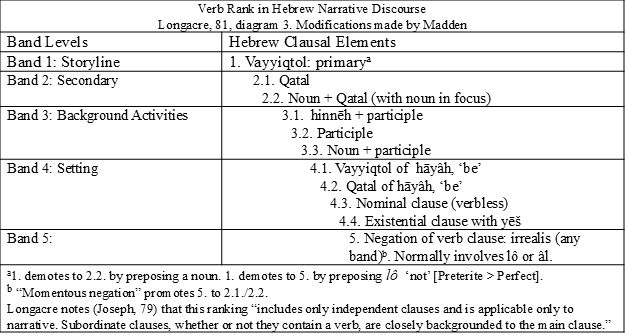
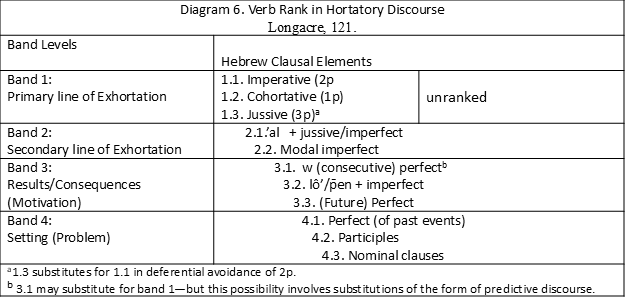
Robert Longacre provides the following table presenting the structure of biblical narrative discourse based on verb types and their function in a passage. This table is followed by his cline for Hortatory Discourse. I have presented these two as they are the two discourse types found in Genesis 1.1-5.
[1] These terms are used as the terminology “Old” and “New” can convey a preference for the New over the Old and the Scriptures are not to be so seen and separated.
[2] Millard J. Erickson, Christian Theology, 2nd ed. (Grand Rapids: Baker Books, 1998), 132ff.
[3] Becky Smethurst, A Brief History of Black Holes (London: Macmillan, 2022), 261.
[4] I had read his Jesus-God and Man years ago and found it to be an outstanding work on Christology.
[5] Andrew Liddle, An Introduction to Modern Cosmology, 3rd ed. (West Sussex: John Wiley & Sons Ltd., 2015).
[6] David Schultz, The Andromeda Galaxy and the Rise of Modern Astronomy (New York: Springer Science+Business Media, 2012).
[7] Koichi Itagaki discovered SN2023ixf, a supernova in the Pinwheel Galaxy (M 101). I have taken a picture of it myself with my equipment. The blue nebula (Oiii emission arc) associated with Andromeda Galaxy (M 31) was discovered by Marcel Drechsler, Xavier Strottner, Yann Sainty, Sean Walker, Stefan Kimeswenger, and Robert Fesen after 180 hours of imaging using amateur equipment.
[11] Schultz, 125-7. E. Hubble, “A spiral nebula as a stellar system, Messier 31.” Astrophysics Journal 79.8 103-64.
[12] Wikipedia contributors, “Nucleosynthesis,” Wikipedia, The Free Encyclopedia, (accessed October 5, 2024). Article and chart.
[13] Hugh Ross, A Matter of Days, 2nd ed. (Covina, CA: rtb Press, 2015), 230-1.
[14] Robert LongacreJoseph: A Story of Divine Providence, 2nd ed., (Winona Lake, IN: Eisenbrauns, 2003). I agree with Ray Clendenen (Revised Malachi) who notes: “I prefer the term text linguistics (or text linguistics) to discourse analysis because of the ambiguity and breadth of the latter term, which is sometimes used of the study of oral speech.” For a helpful survey of various approaches to text linguistics, see Noonan, Advances in the Study of Biblical Hebrew and Aramaic, 145–69. The appeal to me of Longacre’s approach is especially (1) its attention to linguistic levels above that of the clause and sentence, (2) its attention to both form and function in language, that is, both grammatical structure and semantic structure, (3) its attention to linguistic universals, that is, what the study of the world’s ancient and modern languages have in common, and (4) its insistence on meaning-in-context rather than meaning-in-abstract. While Longacre’s focus was on the nature and significance of discourse types, neither he nor his method ignores “other important discourse features, such as discourse relations and information structure,” as Noonan observes (p. 155).
[15] Robert E. Longacre, Joseph: A Story of Divine Providence. 2nd ed. (Winona Lake, Ind.: Eisenbrauns, 2003), xii.
[16] Longacre, following Pike, speaks of tagmemes and syntagmemes; the tagmeme being a constituent element of the higher syntagmeme. He represents it like this: Σ = {T1 . . . Tn}, Tf: (Σ). Robert Longacre, The Grammar of Discourse, 2nd ed. (New York: Plenum Press, 1996), 274.
[17] E. Ray Clendenen,. “The Interpretation of Biblical Hebrew Hortatory Texts: A Textlinguistic Approach to the Book of Malachi” (Ph.D. diss., University of Texas at Arlington, 1989), 45.
[18] Robert E. Longacre, Joseph: A Story of Divine Providence, 2nd ed. (Winona Lake, Ind.: Eisenbrauns, 2003), 57.
[20] Mark E. Ross, “The Framework Hypothesis: An Interpretation of Genesis 1:1-2:3.” In Joseph A. Pipa, Jr., & David W. Hall, editors, Did God Create in 6 Days? (Powder Springs GA: The Covenant Foundation, 1999, 2005),114, n. 1 and 117, n. 6.
I will be utilizing his scheme for evaluating the text of Genesis 1 and for this paper, I will deal only with the first three verses.
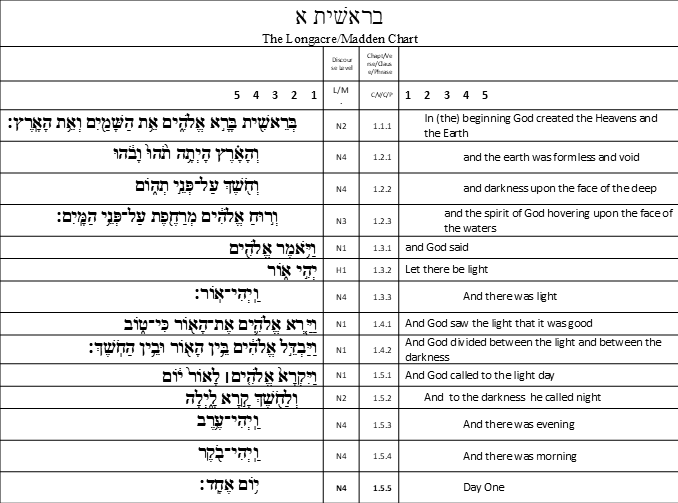
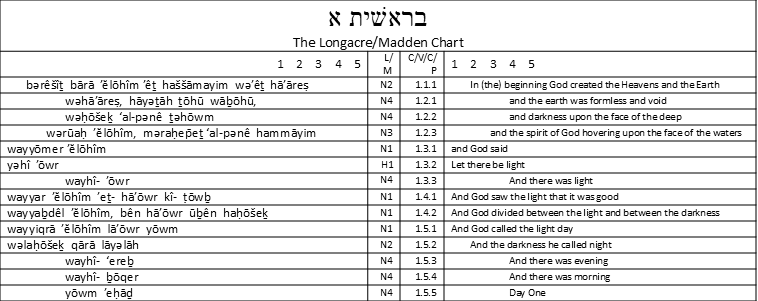
In Hebrew narrative discourse, the mainline of the narration is indicated by the use of the vayyiqtol verb form with the other verb forms providing different levels of separation or support for the mainline. [1] This is what I see as I exegete Genesis 1. In the following pages I have laid it out with the Hebrew text to more visually display the discourse level indentations. I have included a column to show the Chapter/Verse/Clause/Phrase of each line. So too I have included a column to indicate the Discoure Type and Level. As I go through the detailed evaluation I will comment on the linguistics and attempt to coordinate it with my, albeit amatuer, understanding of the Big Bang physics that the text indicates.
The discourse that Longacre in his Joseph first evaluates is the narrative. It is one of the most abundant (if not the most abundant) discourse types in the confines of the Hebrew Bible and thus warrants the closest attention. Moreover, it is consistent enough to serve as an introduction to the concept.
Longacre notes that
A chain of (necessarily verb-initial) clauses that contain preterites [wayiqqtols] is the backbone of any Old Testament story; all other clause types contribute various kinds of supportive, descriptive, and depictive materials. In the cases of clauses that begin with a noun (and therefore cannot contain a verb in the preterite), such background material serves to introduce or highlight something about the noun in question, whether it refers to a participant or to a prop in the story. Clauses that begin with a non-preterite (perfect) verb portray secondary actions; for example, actions what are in some sense subsidiary to the main action, which is described by a following preterite. On occasion, a verb in the perfect (whether or not [the clause] begins with a noun) is repetition or paraphrase of some action already reported as a preterite on the storyline.[2]
He also notes “The special status of hāyâ‘be’” by writing that “It is immediately necessary, however, to qualify the above hypothesis in one important particular. The verb haya, ‘be’, even in its preterite form wahi ‘and it happened’, does not function on the storyline of a narrative. In this respect, the behavior of Hebrew is similar to that of a great many contemporary languages around the world. . . . This is simple [sic] a peculiarity of the verb be in many languages past and present.”[3]
Below I have just the text laid out according to Longacre’s model in Hebrew and English and then Transliterated Hebrew and English. That is followed by my intertexual evaluation and comments.
[1] The old term was qal imperfect with a vav/waw consecutive. My preference is to designate the form of the word (qatal, yiqtol, vayyiqtol, etc.) without assigning any grammatical value to those structures without reference to a discourse type.
The term, “Heavens and Earth” is labeled by many as a merism but I see it more as a specific description of the relationship between the two. The mass and math from the “heavens” are there to make possible the “earth” and the living creatures whom God will call into existence. Cf. esp. Hugh Ross, Designed to the Core (Covina, CA: rtb Press, 2022) and Dean Overman, A Case Against Accident and Self-Organization (Lanham: Rowman & Little-field Publishers, Inc. 1997). An interesting intersection of the discussion of the mass and math relationship be-tween universe and planet earth was depicted in the comedy series Young Sheldon, S02, E03 (originating from the earlier series Big Bang Theory) where, on a Texas porch, the genius and atheist youth, while trying to console his devout Christian mother, that he deeply loves, on an issue, notes that even he, as an atheist has to acknowledge that, “if gravity were slightly more powerful the universe would collapse into a ball; also, if gravity were slightly less powerful there would be no stars or planets.” And that, “gravity is as precisely as it needs to be and if the ratio of the electromagnetic force to the strong force wasn’t 1% life wouldn’t exist. What are the odds that would happen all by itself.” Which leads him to note that the “precision of the universe makes it logical to conclude there’s a creator.” Young Sheldon appears to be noting Stephen Hawking who stated, “If the rate of expansion one second after the Big Bang had been smaller by even one part in a hundred thousand million mil-lion, it would have recollapsed before it reached its present size. On the other hand, if it had been greater by a part in a million, the universe would have expanded too rapidly for stars and planets to form.”
In this view, all of creation began at 1.1 and this includes the heavens (or universe) that is necessary for the crea-tion of the earth which will be the focus of God here and in the rest of Scripture as that is where man, his greatest creation, will live. The separation of the two terms is strengthened particularly in chapter 1 as the two are dealt with separately. The use of the terms “the heavens and the earth” do not necessitate that Moses means the final form. In the lay-ing out of the text, this is an introduction to what will follow and is a note that all that will be began here. Think of the conception of a child – that one, first cell is that child, that youth, that adult.
What is then depicted in vs. 2 is, as I see it from what I have read on the Big Bang Theory, a “. . . seething plasma of subatomic particles” before they “cooled to form hydrogen, the first atoms” as noted above. For me, this is analogous to Jeremiah 1.4-5 where we read, “Now the word of the LORD came to me saying, ‘Before I formed you in the belly[1] I knew you, and before you were brought out from the womb, born I concentrated you . . .” (my translation). The first two phrases are pure nominal clauses simply stating that initial state of the earth, a mass of subatomic particles – formless and void. And in a state of darkness. The third phrase contains a participle, məraḥep̄eṯ, hovering, which some commentators have likened to a hen brooding over her chicks.
[1] There are two Hebrew words in this verse in Jeremiah that the Greek, KJV (Hebrew word here, btn), refers to both the body parts of the man and of the woman to provide their contribution to the formation of a new human being, Jeremiah in this case.
One of the keys for me was noting the word “waters” and then seeing that stated as a description of the plasma state. “The initial result of the Big Bang was an intensely hot and energetic liquid that was around 4 trillion de-grees Fahrenheit (2 trillion degrees Celsius) and existed for mere microseconds. This liquid contained nothing less than the building blocks of all matter. As the universe cooled, the particles decayed or combined, giving rise to … well, everything.”
It is in vs. 3 that matter as we see and know it presently “appears” as that is when the material of creation cooled sufficiently to produce atoms and photons. Once I recognized the production of photons in the cooling process I became convinced that it was significant. One physicist described this as a time before the universe became “transparent.” She goes on to note that at that point we have “the first light in the universe . . . in what we call the Cosmic Microwave Background Radiation [CMB].” I want to ask, as a liberal arts guy, is this also when Einsteinian physics begins – i.e., space and time?
CMB is landmark evidence of the Big Bang theory for the origin of the universe. If my understanding of what I have read is correct, in the Big Bang cosmological models, during the earliest periods, the universe was filled with an opaque fog of dense, hot plasma of sub-atomic particles. From Wikipedia, “As the universe expanded, this plasma cooled to the point where protons and electrons combined to form neutral atoms of mostly hydrogen. Unlike the plasma, these atoms could not scatter thermal radiation by Thomson scattering, and so the universe became transparent. Known as the recombination epoch, this decoupling event released photons to travel freely through space – sometimes referred to as relic radiation. However, the photons have grown less energetic due to the cosmological redshift associated with the expansion of the universe. The surface of last scattering refers to a shell at the right distance in space so photons are now received that were originally emitted at the time of decoupling.”
According to standard cosmology, the CMB gives a snapshot of the hot early universe at the point in time when the temperature dropped enough to allow electrons and protons to form hydrogen atoms. This event made the universe nearly transparent to radiation because light was no longer being scattered off free electrons. When this occurred some 380,000 years after the Big Bang, the temperature of the universe was about 3,000 K. This corresponds to an ambient energy of about 0.26 eV, which is much less than the 13.6 eV ionization energy of hydrogen. This epoch is generally known as the “time of last scattering” or the period of recombination or decoupling.
The two great books of the LORD, Scripture, and the cosmos, were written and completed by God and were intended to be read by man. But, as the gulf between the two is great and severe, it should never be nor ever have been understood to be easily read and understood in the first encounter. This is where Proverbs 25.2 is key. I think that it could be safely argued that part of God’s design of man was a need to investigate and discover – a work that he set out before us. Though beyond our complete comprehension, he did provide the impetus to devise and to discover the means to gain a better and fuller understanding of the wonders he laid out before us that declare his glory.
For the book, this development involved the use of language, and then the move to make it written. Then came the desire to observe and evaluate what others had said and written and in that quest came the recognition of the various forms of words, phrases, sentences, and beyond. And then the investigation and comparison of how the various peoples from this side of the tower of Babylon expressed that grammatical and discourse variety. That was then followed by compilations and coalations of patterns of useage that helped to better determine the meaning of the author. This endeavor is ongoing. Most recently many are recognizing the field of discourse grammar/text liguistics as a vital tools in this inquiry and investigation.
For the cosmos, learning and understanding it has been a quest of millenia. Pure eyeball observation and recording (language helps!) was followed and greatly aided by the invention of the telescope which was followed by improvements and enlargements – the eyeball got bigger and better! This was followed by the invention of the camera which too had its “improvements and enlargements” and today we find ourselves with a telescope and multiple cameras parked one million miles into space designed to peer as deeply back into time as was never imagined much less possible even a few decades ago.
In all of this hermeneutics is key. What has been laid down before us in Scripture is absolute but often it gets poorly exegeted by us. So too nature. There is an absoluteness to it but it too often gets poorly interpreted in man’s approach to it – science. Both these cases are born out by the histories of theological and scientific descriptions since men have approached and observed. As such, I find myself in disagreement with Galileo.
Bibliography
Collins, C. John. Genesis 1-4. Phillipsburg, NJ: P&R Publishing, 2006. Collins, C. John. Reading Genesis Well. Grand Rapids: Zondervan, 2018. Hubble, Edwin. The Realm of the Nebulae. New Haven: Yale University Press, 2013. Kant, Immanuel. Universal Natural History and Theory of the Heavens. Trans. Ian Johnston. Ar-lington: Richer Resources Publications, 2008. Liddle, Andrew. An Introduction to Modern Cosmology. 3rd ed. West Sussex: John Wiley & Sons Ltd., 2015. Overman, Dean. A Case Against Accident and Self Organization. New York: Rowan and Little-field Publishers, Inc., 1997. Pipa, Joseph and David W. Hall, editors. Did God Create in 6 Days? Power Springs, GA: The Cov-enant Foundation, 1999, 2005. Ross, Hugh. Designed to the Core. Covina, CA: rtb Press. 2022. Ross, Hugh. Navigating Genesis. Covina, CA: rtb Press. 2014. Schroeder, Gerald L. Genesis and the Big Bang: The Discovery of Harmony Between Modern Sci-ence and the Bible. New York: Bantam Books, 1990. Smethurst, Becky. A Brief History of Black Holes. London: Macmillan, 2022.
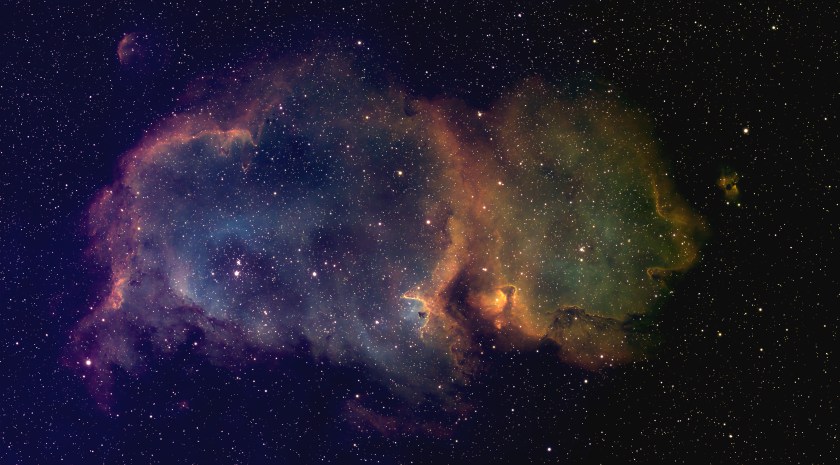
IC 1848, the Soul Nebula (nebula – Latin for cloud or fog), is an emission nebula in the constellation Cassiopeia at about 6,500 light years from us. According to wiki, “An emission nebula is a nebula formed of ionized gases that emit light of various wavelengths. The most common source of ionization is high-energy ultraviolet photons emitted from a nearby hot star.” The other type of nebula is a planetary nebula which “consist[s] of an expanding, glowing shell of ionized gas ejected from red giant stars late in their lives.” Planetary nebula are so named because their round shaped reminded early astronomers of planets.
I made this photo from over 200 photos taken with my astronomy equipment in my back yard in Dallas, TX. The photos were done with filters in front of the camera that captured the photos from the Sulphur, Oxygen, and Hydrogen wavelengths. I could have taken regular Red, Green, and Blue photos to produce a more natural appearance, which shows up using full color cameras as almost entirely red.
I used the camera and filters that I did because at the time there was a full moon in the sky close enough to the nebula that it would have washed out any effort from using a full spectrum camera. Fortunately the filters that I used are unaffected by the moonlight (and city light for that matter) and so I could still produce a picture albeit in the false colors that you see.
The colors you do see are in what is known as the Hubble Pallet where the Sulphur takes the Red place, Hydrogen the Blue, and Oxygen the Green. Though the colors are false, they do make for stunning images! And, most importantly, they make images available when routine and regular techniques will not work for one reason or another.
As I have noted before, the LORD’s two great works for humanity to observe and “read” are his Word and his Universe.
Both have to be read. And there of various ways of reading and interpreting his books. To read the universe the ideal is to find yourself in a very dark area of the planet and see what rotates about you and above you. What you see is screaming “the LORD! The LORD!!” “For since the creation of the world His invisible attributes, His eternal power and divine nature, have been clearly seen, being understood through what has been made, . . .” (Ex 34.6, Romans 1.20). We can peer even closer to that great witness through our telescopes and by using cameras to make the faint images more visible. Direct observation is best, full color spectrum is better, Hubble Palate will suffice to make specifics clearer.
So too with his Word. The best is a direct communication with the LORD himself but that is few and not very likely for us. But, he did give us the Bible, which we can read ourselves. Ideally, if you have been graced with the opportunity, reading his Word in the orginal languages, Hebrew, Aramaic, and Greeks is the best. For most folks, a translation in our native language is the closest we can get, and that is better.
The next level involves us reading what others have written about what they see God’s Word means. This is at the Hubble palette level – it will suffice but is not the ideal, which is actually reading the text for ourselves.
The truth of the matter is that those church writers and commentators present various degrees of false color, some closer than others. On this subject, some have argued that the closer a writer or commentator gets to proximity with the apostles the more their comments are to be accepted and taken as closer than other writers. But, this is a false dichotomy; the argument that proximity necessarily conveys authority. This is easily shown by the fact that each of the letters of the NT are written to communities founded and known directly by the apostles, including Paul. And the letters written are for the most part written as a correction to something someone who knew the apostles got wrong. If they can err, so can anyone who writes anywhere in church history afterwards, even those who many claim are direct students of the apostles.
The truth of the matter is that any writer, even the apostolic writers, are just commentators, no more inspired or insightful than commentators today. They have their strengths and their weaknesses. Modern commentators have the advantage of having all previous writers at their disposal. And, this is very often forgotten, they didn’t all address every subject and they did not all agree. Scripture is the only body of writings that are inspired. None of the church writers are. They may have good (and erroneous) things to say but they all have to be evaluated for veracity or error.
To make the astrophotography connection, the earliest observations made with the telescope did not have a camera to record what was seen. The observers made drawings of what they saw. Galileo’s drawings of Jupiter and its moons, and the mountains of the moon and spots on the sun are some of the earliest and best known. But they are beginning steps to greater understanding. After the telescope the camera became the greatest aid to gaining greater insight into God’s great and vast creation. It was only in the 1930s with the aid of cameras on telescopes was Edwin Hubble (very much aided by Henrietta Leavitt’s work on the Cepheid variable stars) able to determine and make known that our universe extended far past our own Milky Way Galaxy.
All of this to say, what we observe in his books is aided by, not only the earliest observers and commentators but also, and just as importantly, by those whose observations are more recent and who have read what others have written before them.
It is staggering to me all that the LORD has presented to you and I concerning himself, in his word written in the heavens and in his word written that I hold in my hand! And, both are written to all of humanity . . .
When doing Astrophotography of Deep Space Objects (DSO) most folks recommend that you get and use a Guide Scope.
To get good, clear photos of DSOs (galaxies, nebulae, star clusters) you need to keep your camera pointed to the object for hours at a time because you will be taking very many photos of that object (hundreds to thousands of photos because of how dim the object are).
For the most part modern mounts (what the telescope sits on) do a fair job of finding and tracking those objects and keeping them generally align and centered in the camera’s field of view. But, not enough to get accurate, detailed pictures of the object, especially when you are taking so many.
To get the photos right and clear you need a Guide Scope (GS). In the photo you can see the guide scope sitting atop the Imaging Scope (IS). The two scopes need to be aligned and bore sighted to ensure that they will be pointing to the same area of space that your object is in. What you do is to point the GS at a star that is in the field of view as your object and use a program such as PHD (Push Here Dummy according to some sources) to keep the GS locked onto the star and tie the GS camera to the mount (notice the two wires coming off of the GS camera) so that it can send signals to the mount to have it move to keep the guide star centered in the GS camera and thereby keeping the DSO centered in the main imaging camera for the duration of the shoot.
Some folks do astrophotography for the art and beauty of the pictures. Some do it to study the universe in which we reside in an effort to understand more about our place in the grand scheme of things while also appreciating the beauty of the quest as seen in the photos of the stars and planets and galaxies and nebulae and other objects beyond the bounds of our neighborhood.
I like to think that I fall in the latter category. I love the photos I have produced, despite their obvious amateurishness (I hope to get better) and at the same time for me seeing them is a gateway to the understanding and appreciation of the One who set them out there for me to see and wonder over and about.
I have studied this enough to come to the very strong conclusion that what is out there is not a result of unconscious accident. The complexity and beauty of what I see (so too what those who observe the micro biological and physical realms) has got to be from the mind and hands of an Engineer far beyond the capabilities of the greatest minds in the history of the earth. So too, the idea that it all is a matter of sudden appearance from nothing with no cause flies in the face of logic. Dean Overman in his A Case Against Accident and Self-Organization dealt with this nicely. There is someone behind all of this.
Just like the pencil I talked about sitting on my desk, I knew that someone had designed that pencil – it just didn’t pop into existence on its own. It had to have been designed by someone. So too the materials of which it is composed – they just did not pop into existence, and, someone had to design those materials. And this applies to everything in that string of things that I observed were responsible for the fact that I had a pencil on my desk or that Carl Sagan concluded allowed him to enjoy an apple pie.
My study has also led me to the conclusion that that Person is the the God of Abraham and Jesus; YHWH, the God of Israel who gave us the Bible with which to know Him and understand Him and to understand what He would have of us in our relationship with him.
As such, just like if I want to learn and understand what I see through my telescope I need something to guide me. For that I have the Bible as my Guide Scope as it keeps me locked onto the Guide Star who is responsible for both the pencil and me who noticed it! In this I recognize the fact that the One who Designed the Universe is the One who Wrote The Bible. They both have the same Author. Now, before anyone says it, yes, the Bible does not give detailed information concerning the intricacies and the details of sub-quantum things and their design but it does speak enough of who that Engineer is who designs at the sub-quantum/plank level for me to begin to come to a greater understanding of how we fit into this unbelievably vast cosmos.
While reading Genesis 1 have you noticed that light does not show up until verse 3? Depending on how you read it, there is quite a bit of creation and matter long before light shows up.
I have inserted tabs at the beginning of clauses. What the tabs show is varying degrees of primacy in the text – i.e., mainline clause and supporting clauses. The clauses without tabs are the mainline clauses as shown by the specific Hebrew verb form. Clausal forms and elements are the grammatical clues to the hierarchy of the clauses in their relationship to each other and to the overall text. In this text we have a mainline narrative text and a mainline hortatory (imperatival) clause (3a, 3c); a background action clause (1), a background activities clause (2c) and three setting clauses (2a, 2b, 3c).
In evaluating a text, I normally remove the verse markers to get rid of any influence of the versifier and evaluate the text as a literary block. When done this way it can be seen how the text was meant to be read.
The grammatical markers (clausal structure mainly) are the indicators that the author used to show how he wanted the text to flow and what the main point was and what was backgrounding and support structures. I find it useful to think of a stage or a movie scene. You have the background or setting of the stage or scene. Then you have the background activities-things movie around giving more contextual information. Then you have background action – things happening closer to the front of the stage but not quite the main action. Then, closest to the audience and in focus you have the main action. The author of a text sets the stage and demonstrates the action by his clausal elements and structures.
The creation at the beginning (1) sets up what is to follow but did it in such a way as to provide background action to the main action – the creation of light. 2a-c gives the state of the creation prior to the creation of light; it provides the setting and background activity to the stage structure before the main action.
The main action is God speaking light into existence. It is very distinct in the Hebrew text by virtue of the verb form and the fact that that form is always found at the front of the clause.
1-2 is all background and setting. Structured the way it is it can take up any amount of time – microseconds to billions of years. The grammar of the text allows that. Day 1 does not begin until 3a. If you look at the rest of Gen 1 each day begins the same – and God said . . . ; and ends the same – there was evening, there was morning, day umptifratz.
So, in the text we have the Initial Creation with a description of the state of the universe (heavens and earth) prior to the creation of light. Notice that it is a distinct event separated from the initial creation. When I started paying attention to what I was seeing I thought it odd; I have a background in explosives and usually associate Bangs with Light!
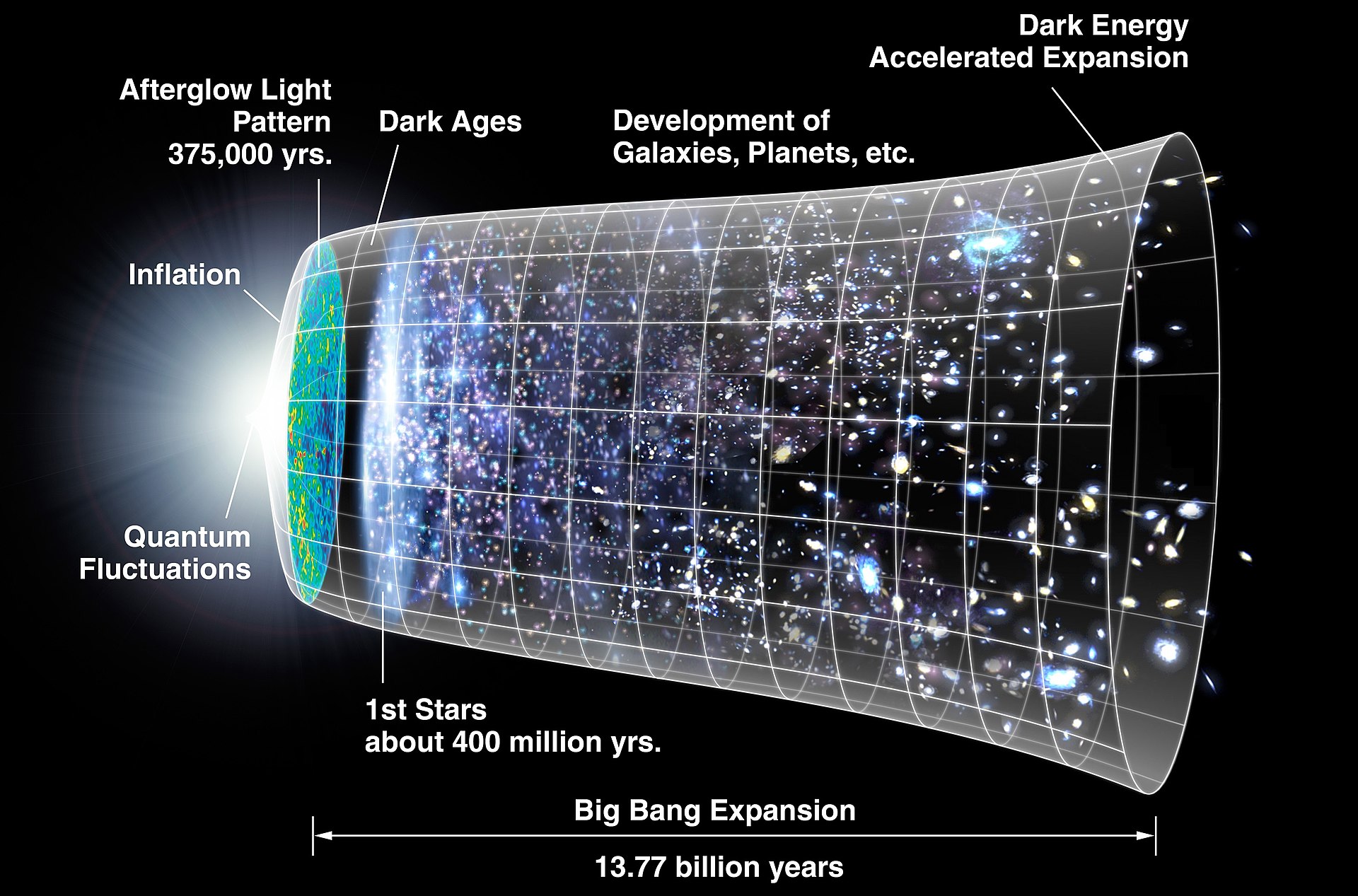
When you look at the theory of the Big Bang and the illustrations of it you find that there is an initial period when the initial universe was too hot for the existence or travel of photons. It is call by some theorists the Cosmic Dark Ages and how long it lasted varies depending on the theorist. Wikipedia’s article on “The Chronology of the Universe” notes, “The Dark Ages and large-scale structure emergence – From 370,000 years until about 1 billion years. After recombination and decoupling, the universe was transparent but the clouds of hydrogen only collapsed very slowly to form stars and galaxies, so there were no new sources of light. The only photons (electromagnetic radiation, or “light”) in the universe were those released during decoupling (visible today as the cosmic microwave background) and 21 cm radio emissions occasionally emitted by hydrogen atoms. The decoupled photons would have filled the universe with a brilliant pale orange glow at first, gradually redshifting to non-visible wavelengths after about 3 million years, leaving it without visible light. This period is known as the cosmic Dark Ages. (https://en.wikipedia.org/wiki/Chronology_of_the_universe)
So here we have an observation from the Text and an observation from Telescopes pointed to the furthest reaches of the observable Creation that show a pause of some value between the initial creation and the creation and emergeance of light. It seems that grammar and science agree.
Not unexpected when we remember that both have the same Author. Who is also an Engineer who designs on the Sub-Atomic (sub-Plank?!) level. And, Who knows Your Name.
To communicate anything there has to be a recognizable set of symbols which both parties are familiar and conversant.
In human language we talk about symbols cultures have created and utilized to convey meaning. Some written languages have symbols that represent the sounds of spoken language. Some symbols represent discrete sounds (alphabets) and some represent syllables (syllabary). Some written languages use the symbols to convey meaning that may not be directly related to sounds or may allow different spoken sounds for the same symbol (pictographic).
For the purposes of this paper I will stick to alphabet languages and use them to relate to other fields and concepts.
In alphabet languages each letter normally represents a particular sound and combinations of letters make more complete sounds like syllables and words. Letters may be combined in a myriad of ways to depict vast numbers of words and meanings.
So too, syllables may be combined in a variety of ways to depict words.
And then words combine to make phrases, clauses, and sentences.
And sentences combine to make paragraphs. And from there we are off to a wide variety of discourse types each laid out to present particular bits of information.
So too with numbers and the language of math and of programming.
Numbers stand alone and relate to other numbers and combine to form specific functions and can be modified by their relationship to decimal points and whether they are on the line, raised above it or lowered below it. Usually, discussions refer to combinations, whether letters or numbers, the value of those in relation to other letters of numbers, and the relationship of those structures to other combinations and groups of combinations.
So, generally, for math discussions not often do folks talk about a single number without mentioning in what context that number or number phrase is found.
So too with letters and words. What those mean is best understood in the context of their presentation. As such, it is more useful to talk not so much about the word as the use of the word in the context of the phrase, clause, paragraph or larger grammatical structure.
So too with punctuation and its relation to the surrounding grammar and the context it is found in.
For instance, in Luke 4 we have a comma whose value so far is 2,000 years.
There we find recorded that Jesus went to his hometown synagogue in Nazareth (small village) and he stood up to read from the book of Isaiah. (Side note – small village synagogue has a copy of Isaiah. More than good chance that small synagogue has then entire TaNaK/OT). The passage is from Isaiah 61.1-2a. The literary extent of the passage extends to verse 11.
In the New American Standard I am looking at, in the Isaiah passage there is a comma at 2a separating it from 2b. The Massoretic notation in the Hebrew text has a zaqeph qaton which is somewhat analogous to a comma.
So why did Jesus stop at 2a?
Contrary to what the Pharisees et al expected, Jesus made the point that the Messiah would First come to Serve and then he would come to Rule. The pause in the passage is the pause between the First Coming Serving Messiah and the Second Coming Ruling Messiah.
As it is, that Comma represents right around 2,000 years!
This is a hint that in other passages there may be found chronological pauses or gaps if we pay attention to the whole of Scripture and pay close attention to the grammatical structure each biblical author was moved to use when the Holy Spirit used them to write God’s Word.
My son in law’s favorite verse is Proverbs 25.2 which says, “[it is the] glory of God to cause the hiding of a thing; and [the] glory of kings to search [for the] thing.”
God created a vast universe, and I argue, he designed, engineered, and created from, at the very least, the sub-quantum level. If we admit to the kind of person that is capable of such and recognize how that is near infinitely beyond both our imaginings and abilities then you recognize what Solomon is saying. It seems that Solomon recognized the greatness of God and also that God made man to want to investigate and search for his ways. Notice that the verse did not say “find or discover”! As many have noted in the things of man, many times it is the quest and journey that is more than the arriving and finding. Some things we have discovered but I think that most will admit we are nibbling at the edges! But what nibblings!
This blog is dedicated to such a quest and discussion. There are varying degrees of a person’s pursuing such a quest, such treasures of “how he did it” that involve looking at both the evidence he lays out before all men in the world around us and the universe above us and also in the text of the Word he gave us as direct communication and revelation.
When doing either you can rely on the work of others that lays out their discoveries. For the text this involves reading translations of the Bible; for the world and universe this involves accessing someone else’s work in the multiplicity of the sciences. Happy is the one who can do some of the investigations on their own either by making their own translations and discoveries in one or all three of the biblical languages (Hebrew, Aramaic, Greek) and/or making their own scientific investigations and discoveries in one or many fields (astronomy, biology, etc.).
As much as possible (but not always) I will be making my own translations (as above with Pr. 25.2) and providing my own photographs to make the point or observation that I will be writing about. To that end I have provided my own translation and here are my earliest photographs of a few of our solar system neighbors.