

IC 1848, the Soul Nebula (nebula – Latin for cloud or fog), is an emission nebula in the constellation Cassiopeia at about 6,500 light years from us. According to wiki, “An emission nebula is a nebula formed of ionized gases that emit light of various wavelengths. The most common source of ionization is high-energy ultraviolet photons emitted from a nearby hot star.” The other type of nebula is a planetary nebula which “consist[s] of an expanding, glowing shell of ionized gas ejected from red giant stars late in their lives.” Planetary nebula are so named because their round shaped reminded early astronomers of planets.
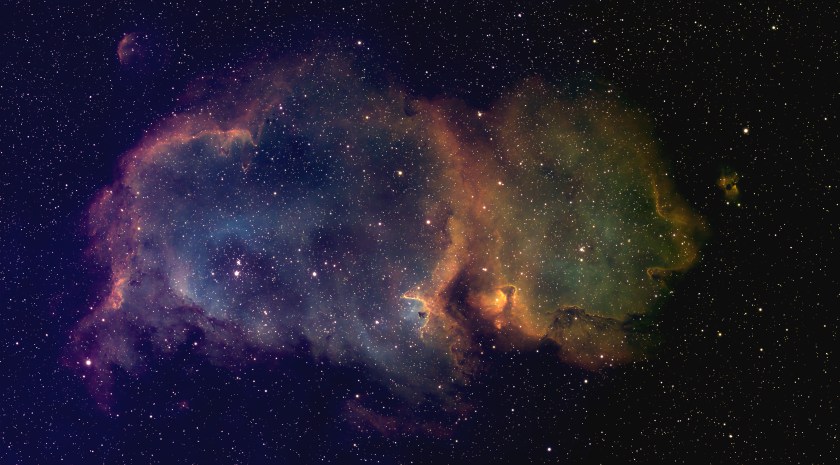
I made this photo from over 200 photos taken with my astronomy equipment in my back yard in Dallas, TX. The photos were done with filters in front of the camera that captured the photos from the Sulphur, Oxygen, and Hydrogen wavelengths. I could have taken regular Red, Green, and Blue photos to produce a more natural appearance, which shows up using full color cameras as almost entirely red.
I used the camera and filters that I did because at the time there was a full moon in the sky close enough to the nebula that it would have washed out any effort from using a full spectrum camera. Fortunately the filters that I used are unaffected by the moonlight (and city light for that matter) and so I could still produce a picture albeit in the false colors that you see.
The colors you do see are in what is known as the Hubble Pallet where the Sulphur takes the Red place, Hydrogen the Blue, and Oxygen the Green. Though the colors are false, they do make for stunning images! And, most importantly, they make images available when routine and regular techniques will not work for one reason or another.
As I have noted before, the LORD’s two great works for humanity to observe and “read” are his Word and his Universe.
Both have to be read. And there of various ways of reading and interpreting his books. To read the universe the ideal is to find yourself in a very dark area of the planet and see what rotates about you and above you. What you see is screaming “the LORD! The LORD!!” “For since the creation of the world His invisible attributes, His eternal power and divine nature, have been clearly seen, being understood through what has been made, . . .” (Ex 34.6, Romans 1.20). We can peer even closer to that great witness through our telescopes and by using cameras to make the faint images more visible. Direct observation is best, full color spectrum is better, Hubble Palate will suffice to make specifics clearer.
So too with his Word. The best is a direct communication with the LORD himself but that is few and not very likely for us. But, he did give us the Bible, which we can read ourselves. Ideally, if you have been graced with the opportunity, reading his Word in the orginal languages, Hebrew, Aramaic, and Greeks is the best. For most folks, a translation in our native language is the closest we can get, and that is better.
The next level involves us reading what others have written about what they see God’s Word means. This is at the Hubble palette level – it will suffice but is not the ideal, which is actually reading the text for ourselves.
The truth of the matter is that those church writers and commentators present various degrees of false color, some closer than others. On this subject, some have argued that the closer a writer or commentator gets to proximity with the apostles the more their comments are to be accepted and taken as closer than other writers. But, this is a false dichotomy; the argument that proximity necessarily conveys authority. This is easily shown by the fact that each of the letters of the NT are written to communities founded and known directly by the apostles, including Paul. And the letters written are for the most part written as a correction to something someone who knew the apostles got wrong. If they can err, so can anyone who writes anywhere in church history afterwards, even those who many claim are direct students of the apostles.
The truth of the matter is that any writer, even the apostolic writers, are just commentators, no more inspired or insightful than commentators today. They have their strengths and their weaknesses. Modern commentators have the advantage of having all previous writers at their disposal. And, this is very often forgotten, they didn’t all address every subject and they did not all agree. Scripture is the only body of writings that are inspired. None of the church writers are. They may have good (and erroneous) things to say but they all have to be evaluated for veracity or error.
To make the astrophotography connection, the earliest observations made with the telescope did not have a camera to record what was seen. The observers made drawings of what they saw. Galileo’s drawings of Jupiter and its moons, and the mountains of the moon and spots on the sun are some of the earliest and best known. But they are beginning steps to greater understanding. After the telescope the camera became the greatest aid to gaining greater insight into God’s great and vast creation. It was only in the 1930s with the aid of cameras on telescopes was Edwin Hubble (very much aided by Henrietta Leavitt’s work on the Cepheid variable stars) able to determine and make known that our universe extended far past our own Milky Way Galaxy.

All of this to say, what we observe in his books is aided by, not only the earliest observers and commentators but also, and just as importantly, by those whose observations are more recent and who have read what others have written before them.
It is staggering to me all that the LORD has presented to you and I concerning himself, in his word written in the heavens and in his word written that I hold in my hand!
And, both are written to all of humanity . . .
And to me! The God of the Universe knows my name!


 The Text and the Telescope